- Your output is your team's output: Grove's central sentence is that a manager's output is the output of the organizational units under their supervision or influence.
- Run management like a production process: The breakfast factory teaches limiting steps, offset scheduling and inspection points, and Grove insists the same operations run in every office.
- Meetings are the medium, so design them: A meeting is the medium through which managerial work is performed, so the only useful question is how well each one is run.
- A goal system answers two questions: Where do I want to go gives you the objective, and how will I pace myself gives you the key results.
- Keep the number of objectives small: Focus is the one thing an MBO system delivers better than anything else, and focus survives only on a short list.
- Pair every indicator with its counter-indicator: Measurement steers behavior, so each indicator needs a partner that measures the counter-effect it would otherwise push you into.
- Match your style to task-relevant maturity: No management style wins everywhere, because the right style depends on how mature a person is on the specific task at hand.
- Keep goals out of the performance review: Grove calls the MBO system a pacing device rather than a legal document on which to base a performance review.
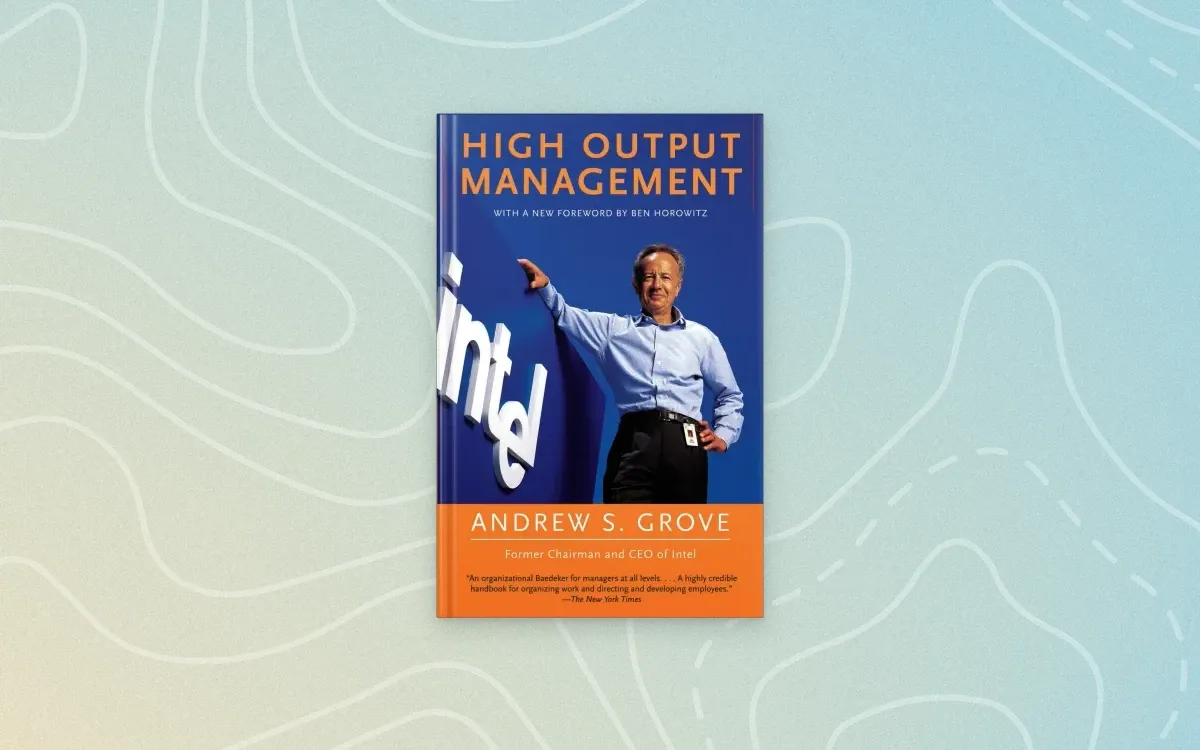
High Output Management by Andrew S. Grove is a manual for managerial work written from inside the job, by the Intel president who later became its chief executive. This summary distills its core insights into eight takeaways you can apply to how your organization sets, paces and reviews its goals.
About High Output Management
Andrew S. Grove (1936 to 2016) emigrated to the United States from Hungary in 1956, participated in the founding of Intel, became its president in 1979 and its chief executive officer in 1987, and was Time magazine's Man of the Year in 1997. He taught at the Stanford University Graduate School of Business for twenty-four years, and he wrote this book himself rather than through a ghostwriter.
Random House published it in 1983, Vintage reissued it in 1995 with a new introduction by Grove, and Vintage reissued it again in 2015 with a foreword by Ben Horowitz. Grove is reacting against two things: management books of the era written by consultants rather than by operators, and the neglect of middle managers, whom he calls the muscle and bone of every sizable organization no matter how flattened the hierarchy.
The book never reached a bestseller list in the 1980s or 1990s, and its reputation is entirely retrospective, built by Silicon Valley founders decades later. It is also the reason so many lists of the best OKR books start here: this is the text John Doerr carried out of Intel and eventually took to Google.
Key takeaways
The eight takeaways below follow the shape of the book. The first three are Grove's theory of managerial work, the middle three are his goal and measurement system, and the last two are about the people the system runs on.
1. Your output is your team's output
Grove puts a question to a group of middle managers: what is a manager's output? The answers come back as judgments and opinions, direction, allocation of resources, mistakes detected, personnel trained, courses taught, products planned and commitments negotiated.
He rejects every item on the list. Each one describes something a manager does while trying to create a result, not the result itself.
What Grove's managers called a manager's output
- Judgments and opinions
- Direction
- Allocation of resources
- Mistakes detected
- Personnel trained and subordinates developed
- Courses taught
- Products planned
- Commitments negotiated
His replacement definition is the sentence he calls the single most important one in the book.
The consequence is that managerial skill counts for nothing until it shows up in what other people produce. Grove borrows the image from sport: a coach or a quarterback does not score touchdowns alone, and the league standings are kept by team rather than by individual.
From there he builds the concept the book is really organized around. Every managerial activity carries a leverage, meaning the amount of team output it moves, and total managerial output is each activity multiplied by its leverage and then summed. That leaves exactly three ways to raise a manager's productivity.
Two of the three have nothing to do with working harder, and that is the point. The same hours spent on different activities produce very different amounts of team output.
2. Run management like a production process
Part I of the book is a breakfast factory. Grove asks you to serve a three minute egg, buttered toast and coffee, all delivered at the same time and all hot, and then extracts the general principles from what that takes.
Find the limiting step, which is the egg because it takes longest, build the schedule backwards from delivery using time offsets, and put inspection points where a defect is cheapest to catch.
What makes this more than a cute analogy is his claim that only three types of production operation exist anywhere, and that all three are running in college recruiting, sales training and compiler design just as they are in a kitchen.
Type of operation | What it does, in Grove's terms |
|---|---|
Process manufacturing | Physically or chemically changes material, just as boiling changes an egg |
Assembly | Puts components together to constitute a new entity, as the egg, the toast and the coffee make a breakfast |
Test | Subjects the components or the total to an examination of its characteristics |
Production, in his definition, has to build and deliver products in response to the demands of the customer at a scheduled delivery time, at an acceptable quality level, and at the lowest possible cost. Every clause of that is a constraint a planning cycle is under too.
This is also the part of the book its critics attack hardest, because the frame is built for throughput rather than for people. Grove never backed away from it: in his 1995 introduction he wrote that the breakfast factory is every bit as much the ideal now as it was when he wrote the book.
3. Meetings are the medium, so design them
Grove refuses the premise that meetings are a tax on real work. A manager's two basic tasks, supplying information and know-how and making or helping to make decisions, happen in face-to-face encounters, which means they happen in meetings.
He then splits them in two. Process-oriented meetings are regularly scheduled and exist to share knowledge, mission-oriented meetings are called ad hoc and exist to produce a decision, and Intel ran three kinds of the first type: the one-on-one, the staff meeting and the operation review.
The one-on-one is the one the industry copied, and the chapter is useful because Grove answers the questions most management books avoid.
Grove's answers on running a one-on-one
- Frequency: once a week with someone inexperienced in a specific situation, perhaps once every few weeks with an experienced veteran.
- Length: an hour at a minimum, because anything less pushes the report toward simple things that can be handled quickly.
- Location: in or near the report's own work area, because a supervisor learns a lot simply by going there.
- Ownership: it is the report's meeting, and the supervisor is there to learn and to coach.
- Technique: his principle of didactic management is to ask one more question when you think the other person has finished.
Both people keep an outline and take notes on it, and both keep a hold file of items worth batching for the next session. It is a designed process rather than a chat, which is the whole argument.
Grove revised only the cadence in 1995. Email and flatter organizations, he wrote, let you deal with more employees less frequently and in meetings of shorter duration, and he still answered the question of whether one-on-ones are needed with an unqualified yes.
4. A goal system answers two questions
This is where OKRs come from, and it is smaller than its reputation. Management by objectives is not a part or a chapter of this book, it is a short stretch of the planning chapter where Grove treats it as planning applied to the next few months of daily work.
His statement of the underlying idea is that if you do not know where you are going, you will not get there. He then reduces the entire system to two questions.
The answer to the first question is the objective. The answer to the second gives you the milestones, which Grove also calls key results.
Notice that the second question is about pacing rather than about measurement, and that is the detail most retellings lose. Grove's own illustration is a drive to catch a plane, with towns to be reached at ten, twenty and thirty minutes, so that twenty minutes without reaching the first town tells you that you are lost.
Two rules follow. Key results need very specific wording and dates so that no ambiguity is left when the deadline arrives, and the cycle has to be short enough that feedback arrives soon after the activity it measures, which for annual planning means quarterly or even monthly.
The nesting rule is one line: if the subordinate's objectives are met, the supervisor's will be as well. That is management by objectives as Grove ran it at Intel, and it is recognizably the same machine most companies now run under a different name.
5. Keep the number of objectives small
Grove is unusually direct about what the system is actually for.
He is equally direct about why lists grow anyway, and it is an inability to say no. Earlier in the same chapter he states the cost plainly: by saying yes to a project or a course of action you are implicitly saying no to something else, and each commitment you make forfeits a commitment you could have made instead.
That puts an uncomfortable obligation on whoever runs planning. People who plan, he writes, need the guts, honesty and discipline to drop projects as well as to initiate them, to shake their heads no as well as to smile yes.
Grove's closing exercise for the reader
- Define the three most important objectives for your organization for the next three months.
- Support them with key results.
Three objectives for three months is a tighter constraint than most goal programs impose on themselves, which is why an overloaded list remains one of the most common OKR mistakes forty years later.
6. Pair every indicator with its counter-indicator
Grove's warning is that measurement is never neutral, because the act of tracking something changes where attention goes.
Watch inventory on its own and you will drive inventory down until you are creating shortages. His fix is to pair indicators, so that both the effect and the counter-effect are measured and neither can be optimized in isolation.
Indicator | Its paired counter-indicator |
|---|---|
Inventory levels | Incidence of shortages |
Software unit completion date | The unit's capability |
Number of vouchers processed | Quality of the work processed |
Breakfasts delivered per waiter | Customer complaint log |
The third row follows his general rule for administrative work rather than a worked example: where the indicator counts quantity, its partner should stress the quality of the work.
Two prior rules sit underneath the pairing. Any measurement is better than none, and a genuinely effective indicator covers the output of the work unit rather than the activity involved, which is why you measure a salesman by the orders he gets and not by the calls he makes.
7. Match your style to task-relevant maturity
Grove reports the research finding that undercuts every book promising one best leadership style: controlled experiments could not show that any style consistently beat another.
His resolution is that the effective style depends on the person's maturity on the specific task at hand rather than their maturity in general. Task-relevant maturity combines achievement orientation and readiness to take responsibility with education, training and experience, and it is entirely possible for someone to be high on one job and low on another.
The cautionary case is an Intel manager moved from the field into a factory unit, whose performance collapsed even though the person had not changed. Grove's diagnosis is that they had confused the manager's general competence and maturity with his task-relevant maturity.
Two guard rails come with the model. Whatever the maturity, monitor a person's work closely enough to avoid surprises, and do not make a value judgment that treats the structured style as less worthy than the communication-oriented one.
He is also unsentimental about letting people learn by failing in front of customers. When an associate defended a junior hire's poor work on the grounds that he has to make his own mistakes, Grove's answer was that the subordinate's tuition is being paid by his customers, and that this is absolutely wrong.
8. Keep goals out of the performance review
In 1983 Grove settled an argument the OKR industry is still having, and he settled it against using the goal system as an evaluation instrument.
He works it through Columbus. Columbus obtained his ships, trained his crews, completed a shakedown cruise and set sail, hitting every key result, and then missed his objective of a new route to the Orient by discovering the New World instead.
Grove's Columbus example
Objective, missed | Key results, met |
|---|---|
Find a new route to the Orient | Ships obtained, crews trained, shakedown cruise completed, set sail |
Grove's verdict is that Columbus performed well anyway. The system exists to pace a person, and his image for it is a stopwatch placed in that person's own hand.
He is then explicit about what the MBO system is not.
He names both failure modes in one sentence. A supervisor who relies on the system mechanically to evaluate a subordinate, and a subordinate who follows it rigidly and forgoes an emerging opportunity because it was not a specified objective or key result, are both behaving in a petty and unprofessional fashion.
None of this makes Grove soft on appraisal. He calls the review one of a manager's highest leverage activities and says its fundamental purpose is to improve the subordinate's performance, which is precisely why he will not let the goal system stand in for it. Four decades on, that remains the cleanest available answer to how OKRs and performance management should relate.
High Output Management book review and limitations
High Output Management holds a 4.30 rating on Goodreads from over 22,000 readers. The publisher's own blurb carries one press line, from The Wall Street Journal: "Generous enough with advice and observations to be required reading." However, reviewers have noted several limitations.
The production metaphor never closes the loop: Grove opens with the breakfast factory and returns to it for four chapters, but limiting steps, offsets and inspection points are the wrong primitives for the people chapters that follow. Reviewers report that the frame is set up and then quietly abandoned, and that the same device works better in Eliyahu Goldratt's The Goal, published a year later.
The people in it are roles rather than people: Everyone appears as a function: the subordinate, the Far East construction manager, the sergeant. Grove instructs the reader to strip warmth out of style choices, arguing that what is nice or not nice has no place in how a manager thinks or acts, and readers who otherwise rate the book highly single this out.
The evidence is one exceptional company, described by the person who ran it: Every case is Intel or an Intel-shaped analogy, with no comparison against firms that managed differently and no data beyond Grove's own recollection. Nothing here separates the practices that caused Intel's results from the practices that merely accompanied them.
The OKR lineage is thinner in the book than its reputation implies: The term OKR appears nowhere in the 1983 text, and management by objectives occupies roughly six pages inside a planning chapter, worked through Columbus and a Philippine plant expansion. A reader who buys the book because it is where OKRs came from gets a short section in the vocabulary of 1983, not a system.
Who should read this book?
The intended reader is the middle manager, and Grove says so repeatedly. It lands best with engineering, operations and functional managers who have a handful of direct reports in an organization of roughly 50 to 5,000 people, where a process already exists and the question is how to make it produce more.
First-time managers get the most concrete return, because Grove answers the operational questions most management books refuse: how long a one-on-one runs, where it happens, who owns the agenda. Grove also widens the audience himself to know-how managers, people who influence the work of others without supervising anyone, and names teachers, market researchers and traffic engineers among them.
For a goals audience specifically, the value is Grove's own authority behind two arguments that are hard to win internally: keep the number of objectives small, and keep the goal system out of the appraisal machinery.
It lands less well for executives looking for strategy, since the book is about management craft and says nothing about what to build or which market to enter. It also assumes people share a building, and Grove's own 1995 update on that question stops at email, so anyone running distributed or asynchronous teams will be translating as they read.
Related reading
Mooncamp resources
- OKR vs MBO: The differences and similarities between Grove's system and the OKRs that descend from it
- OKR Check-in: The modern descendant of Grove's one-on-one and his short feedback cycle
- The Goal Book Summary: Goldratt's production-line novel, the comparison Grove's own reviewers keep drawing
- The Hard Thing About Hard Things Book Summary: Ben Horowitz, who wrote the 2015 foreword, running Grove's playbook in a crisis
Related books
- Measure What Matters by John Doerr: The direct descendant, written by the Intel employee who renamed the practice OKRs and took it to Google
- The Goal by Eliyahu M. Goldratt: The same idea of teaching management through a production line, published a year later and, in the judgment of Grove's own reviewers, better executed
- The Hard Thing About Hard Things by Ben Horowitz: The field report from someone who applied Grove's ideas under conditions Grove never faced
- Only the Paranoid Survive by Andrew S. Grove: Grove's own follow-up, about noticing that the machine is pointed at the wrong thing