An OKR trainer is a specialist who teaches teams and organizations how to set, track, and achieve Objectives and Key Results. Whether you are looking to hire an external trainer for your company or exploring OKR certification for yourself, this guide covers everything you need to make an informed decision.
OKRs have moved from a Silicon Valley niche to a global standard. Nearly half of Fortune 500 companies now use OKRs, and according to Mooncamp's OKR statistics, 83% of companies report a positive impact on their organization.
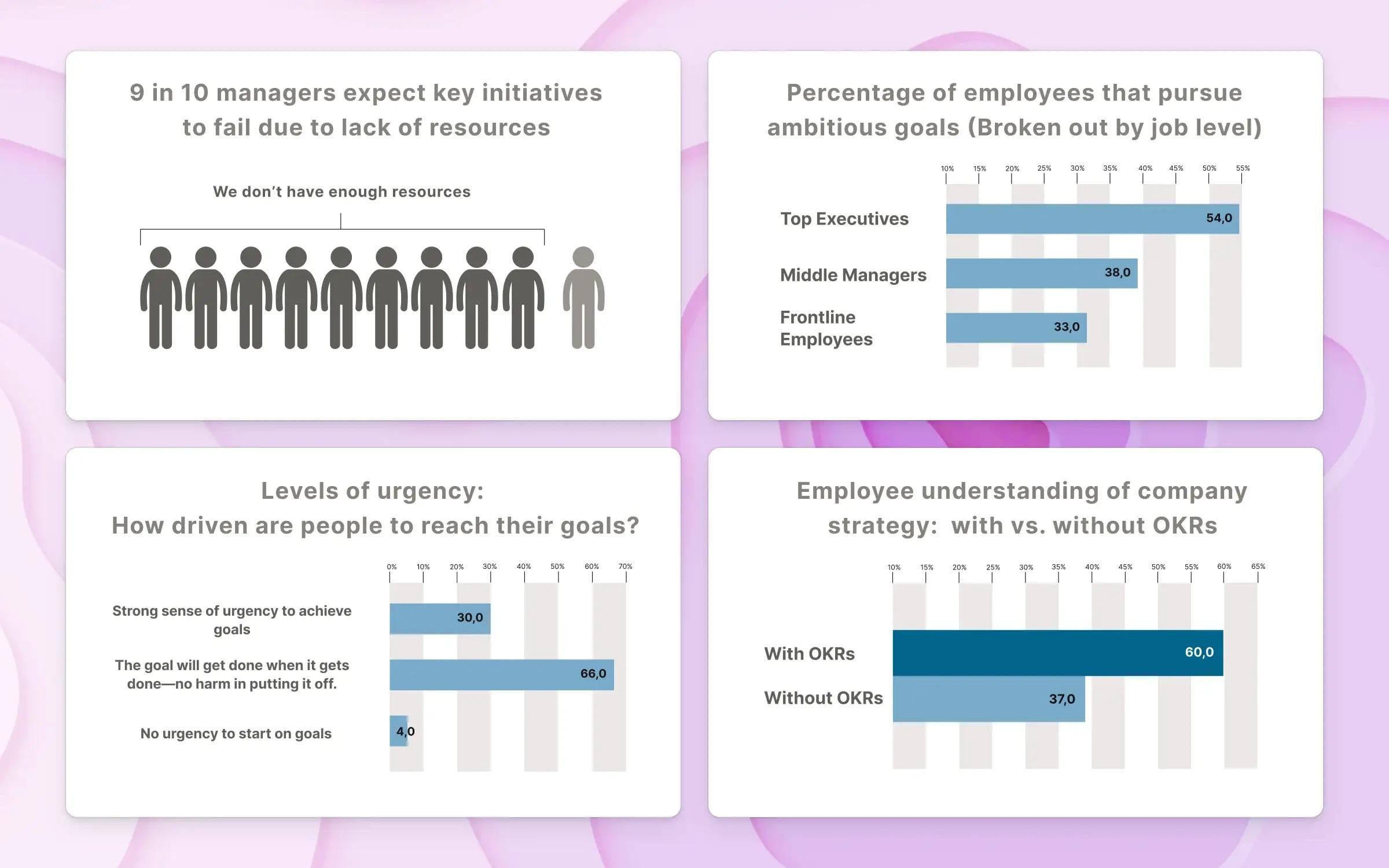
Yet adoption remains the hard part. A Bersin by Deloitte study found that organizations with clear, structured goal-setting practices are four times more likely to score in the top 25% of business outcomes. Still, 71% of OKR adopters say they have not fully mastered the framework (OKRs Tool, 2025).
This is exactly where OKR trainers add value. Over 80% of successful OKR companies rely on dedicated coaches or trainers to manage the process, and that is the role we will unpack here.
This guide is for HR leaders, operations managers, and team leads evaluating OKR training options. It is also useful for professionals considering OKR coaching as a career path.
What does an OKR trainer do?
An OKR trainer teaches individuals and teams how to use the OKR framework effectively. Their core job is to transfer knowledge so that an organization can run OKR cycles independently.
In practice, the trainer's responsibilities include:
- Teaching the OKR fundamentals: explaining how to write OKRs, the difference between Objectives, Key Results, and initiatives, and how OKR cycles work.
- Facilitating workshops: running OKR workshops where teams draft their first OKRs and align across departments.
- Training different audiences: adapting the material for executives (strategic alignment), team leads (cascading and ownership), and individual contributors (writing measurable Key Results).
- Coaching through the first cycles: supporting teams during their first two to three OKR cycles as they learn to check in on progress, score results, and adjust.
- Building internal capability: training internal OKR champions who can eventually take over the role.
Good OKR training does not end after a single workshop. The best trainers guide organizations through at least two full OKR cycles, because the real learning happens when theory meets quarterly reality.
OKR trainer vs. OKR coach vs. OKR consultant
These three roles overlap, and many practitioners wear more than one hat. Still, the distinction matters when you are hiring.
OKR Trainer | OKR Coach | OKR Consultant | |
|---|---|---|---|
Primary focus | Teaching the framework | Guiding ongoing practice | Designing the system |
Engagement type | Workshops, courses, certifications | Recurring sessions over multiple cycles | Project-based engagement |
When to hire | At the start (rollout) | During the first 2-4 cycles | When you need custom OKR architecture |
Typical duration | 1-5 days | 3-12 months | 4-8 weeks |
Output | Trained teams, internal knowledge | Improved OKR quality cycle over cycle | OKR playbook, governance model |
Analogy | Driving instructor | Driving companion on your first road trips | The person who designs the road |
Most organizations start with training, then move to coaching as they scale OKRs across the company.
When does your organization need an OKR trainer?
You need an OKR trainer when your organization lacks hands-on OKR experience and cannot afford to learn through trial and error alone. The following situations are the most common triggers.
- First-time OKR rollout: your team has read books and articles but nobody has hands-on experience writing and running OKR cycles.
- Failed past attempts: you tried OKRs before but they fizzled out after one or two quarters. This is one of the most common OKR mistakes.
- Scaling beyond a pilot: OKRs worked in one team, and now you need a consistent approach across the organization.
- Leadership misalignment: executives have different mental models of what OKRs are, leading to conflicting expectations.
- Framework confusion: teams confuse OKRs with KPIs, to-do lists, or performance review targets.
When you probably do not need one
External training is not always necessary. Consider skipping it if:
- Your team is small (under 15 people): a founder or team lead can learn from OKR books and free courses, then run a simple first cycle. The stakes are low and iteration is fast.
- You already have internal expertise: if someone on the team has successfully run OKR cycles at a previous company, they can train others.
- You do not have a clear strategy yet: OKRs translate strategy into execution. If the company strategy is undefined, OKR training is premature. Fix strategy first.
- Culture is not ready for transparency: OKRs require open goal-setting and public progress tracking. If leadership is not prepared for that, training alone will not fix the cultural gap.
What good OKR training covers
Not all OKR training is equal. Here is what separates a strong curriculum from a surface-level overview.
Essential topics
A strong OKR training curriculum covers six core areas, from basic definitions through to real-world pitfalls.
- OKR fundamentals: Objectives vs. Key Results vs. initiatives, OKR scoring, and the difference between committed and aspirational OKRs.
- Writing effective OKRs: how to formulate outcome-driven Key Results and avoid the common trap of listing outputs instead. See our guide on how to write OKRs for a primer.
- Alignment and cascading: how company OKRs connect to team OKRs, and how cross-functional dependencies are managed.
- The OKR cycle: planning, check-ins, reviews, and retrospectives, and how these fit into an existing meeting cadence.
- OKRs alongside other frameworks: how OKRs relate to KPIs, Agile methodologies, and performance management.
- Common pitfalls: the mistakes that derail OKR rollouts, from setting too many Objectives to treating Key Results as tasks.
What separates good from mediocre training
The difference between training that sticks and training that gets forgotten is whether participants practice with their own real goals, not hypothetical case studies.
- Hands-on practice: participants write real OKRs for their own teams during the training, not hypothetical examples.
- Audience-specific tracks: executives need strategic alignment sessions, while team leads need facilitation skills and individual contributors need writing practice.
- Post-training support: at minimum, a follow-up session after the first OKR cycle to review what worked and what did not.
- Tool integration: practical guidance on how to track OKRs in software (spreadsheets, dedicated OKR tools, or project management platforms).
Top OKR certification programs
The OKR certification landscape has no single governing body, so credentials vary in rigor and recognition.
Program | Provider | Format | Duration | Price | Best for |
|---|---|---|---|---|---|
OKR Certification: Leadership and Goal Setting | Coursera / Measure What Matters | Self-paced online | ~18 hours | Free (audit) / Coursera Plus subscription for certificate | Individuals wanting foundational knowledge |
OKR Coach Certification | WorkBoard | Live online | 2 half-days | $599 | Internal OKR champions and coaches |
OKR Foundation + Practitioner | OKR Institute (OKRI) | Self-paced + live sessions | Foundation: self-paced; Practitioner: 5 weeks (1.5h/week) | Foundation: free; Practitioner exam: $100 | Progressive learning path from beginner to practitioner |
OKR-BOK Certified Coach | OKR International | Live online | 2 days (16 hours) | $1,999 | Experienced coaches and consultants |
Certified OKR Trainer | OKR Consortium | Live (tiered program) | Varies by tier | Contact for pricing | Professionals who want to train others |
OKR Certification Live Online | Balanced Scorecard Institute | Live online | 6 sessions | Contact for pricing (Essentials module: $495) | Organizations already using Balanced Scorecard |
How to pick the right certification
The right certification depends on whether you want to learn OKRs for yourself or train others professionally. Four factors should guide your decision.
- Your goal: if you want to understand OKRs for personal use, a self-paced course is enough. If you will coach teams, invest in a live program with practice components.
- Format preference: self-paced courses offer flexibility. Live cohort programs offer networking and real-time feedback.
- Employer recognition: no OKR certification carries the weight of, say, a PMP. Practical experience matters more than the credential itself.
- Budget: free and low-cost options exist for foundational knowledge. Premium programs ($600 to $2,000) add live facilitation and peer practice.
How to choose the right OKR trainer
Credentials and experience
Certifications matter less than implementation track record. Prioritize trainers who have personally run OKR rollouts, not just taught the theory.
- Hands-on implementation experience: a trainer who has personally led OKR rollouts inside organizations (not just taught the theory) will give better advice. Ask how many companies they have worked with and at what scale.
- Industry familiarity: OKR training for a 50-person startup looks different from training for a 5,000-person enterprise. Make sure the trainer has experience at your company's stage and size.
- References and case studies: ask for three references from companies similar to yours. Good trainers are happy to share results.
Methodology and approach
How a trainer delivers content matters as much as what they teach. Look for signs that the engagement is tailored, not off-the-shelf.
- Customization: avoid trainers who deliver a one-size-fits-all slide deck. The best trainers adapt their material to your industry, maturity level, and existing processes.
- Post-training support: one workshop rarely sticks. Ask whether the engagement includes follow-up coaching or check-ins during the first OKR cycle.
- Alignment with your tools: if your team uses OKR software, the trainer should incorporate it into the training rather than ignoring it.
Red flags to watch for
Some warning signs should disqualify a trainer regardless of their credentials or price point.
- Guaranteeing specific business outcomes from OKR training (no trainer can promise revenue growth).
- Insisting their proprietary framework is the "only correct" OKR methodology.
- No post-training support or follow-up plan.
- Unable to explain how OKRs differ from KPIs or SMART goals.
How much does OKR training cost?
OKR training costs vary widely depending on the format and depth.
Format | Typical price range | What you get |
|---|---|---|
Self-paced online course | Free to $100 | Video lessons, quizzes, basic certificate |
Live virtual workshop (group) | $500 to $2,000 per person | Interactive training, hands-on OKR writing, Q&A |
On-site workshop (corporate) | $3,000 to $15,000 per day | Customized training for your organization |
1:1 OKR coaching | $150 to $500 per hour | Personalized guidance over multiple sessions |
Enterprise program (training + coaching) | $10,000 to $50,000+ | Full rollout support over 2-4 quarters |
Hidden costs to budget for
The trainer's fee is only part of the total investment. Employee time, tooling, and follow-up coaching often exceed the initial training cost.
- Employee time: a full-day workshop for 20 people is 160 hours of productive time redirected.
- OKR software: most organizations eventually adopt a tracking tool, adding a per-user monthly cost.
- Ongoing coaching: the initial training is rarely the end. Budget for at least one follow-up session per quarter during the first year.
Internal vs. external OKR training
You do not have to hire an outside expert. Many organizations build internal OKR training capability through an OKR champion model.
The OKR champion model
An OKR champion is an employee (often in operations, HR, or strategy) who becomes the in-house OKR expert. They typically attend an external OKR certification, then train and coach their own teams.
According to Mooncamp's OKR Impact Report, over 80% of companies with successful OKR programs have a dedicated OKR coach or champion role.
When to go external vs. internal
Factor | External trainer | Internal champion |
|---|---|---|
Speed | Faster to start (immediate expertise) | Slower ramp-up (needs to learn first) |
Cost | Higher upfront, lower ongoing | Lower upfront, higher ongoing (salary allocation) |
Credibility | Outside expert often has more authority with leadership | May struggle to get buy-in from peers |
Customization | Good trainers adapt, but still outsiders | Deep understanding of company culture and politics |
Sustainability | Dependency on external availability | Knowledge stays in the organization |
The most effective approach is often a combination: hire an external trainer for the initial rollout, then invest in certifying an internal champion to carry the practice forward.
How to measure OKR training success
Training only matters if it changes behavior. Deloitte's research found that organizations reviewing goals quarterly or more frequently are 3.5 times more likely to achieve strong business outcomes (Bersin by Deloitte). Good OKR training instills exactly this cadence.
Short-term indicators (first cycle)
In the first cycle after training, look for whether teams can independently produce quality OKRs without heavy revision.
- Teams can write OKRs that meet quality criteria: outcome-focused Key Results, 2-4 Objectives per team, measurable targets.
- OKR drafts require fewer revision rounds than before training.
- Teams complete their first OKR planning session within the allotted time.
Medium-term indicators (2-4 cycles)
By the second to fourth cycle, the OKR practice should be self-sustaining with consistent cadence and improving quality.
- Check-in completion rates above 70%.
- OKR scoring happens consistently at the end of each cycle.
- Teams proactively adjust OKRs mid-cycle when circumstances change, rather than abandoning them.
Long-term indicators (4+ cycles)
After a year of OKR practice, the framework should be embedded in how the organization makes decisions, not just a quarterly ritual.
- Cross-team alignment improves: fewer conflicting priorities between departments.
- Internal champions can train new hires on OKRs without external help.
- OKRs are referenced in daily decisions, not just in quarterly planning rituals.
The most telling metric is the simplest: do teams continue using OKRs after the training is over? If OKRs get abandoned by quarter three, the training did not transfer.