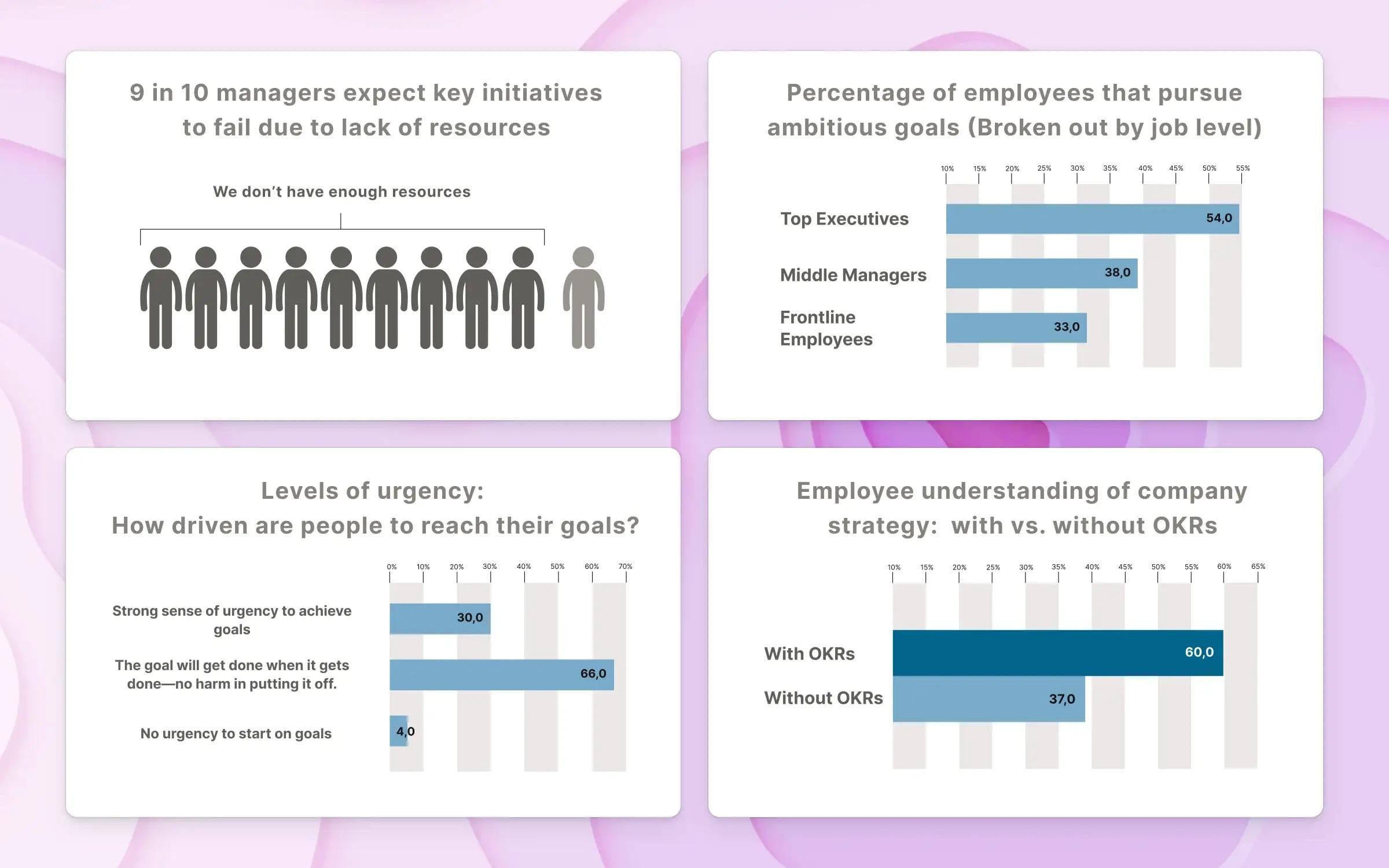
The difference between 4DX (4 Disciplines of Execution) and OKRs (Objectives and Key Results) is altitude: OKRs are a quarterly goal-setting framework for strategic direction, while 4DX is a weekly execution operating system for teams whose daily work crowds out that strategy.
Most comparisons treat them as rival choices. They are not. FranklinCovey, the company that created 4DX, actually positions it as the execution layer that runs underneath OKRs.
This guide compares 4DX and OKRs across every dimension that matters, shows the same goal modeled in both frameworks, explains where each one fails, and helps you decide whether to pick one, the other, or run both together.
- OKRs set direction, 4DX drives execution. OKRs answer "what's most important this quarter?" with an Objective plus 2 to 5 Key Results. 4DX answers "what will we actually do this week to move it?" with a Wildly Important Goal, lead measures, a scoreboard, and a weekly cadence.
- The best of both is often a hybrid. Use OKRs for quarterly strategic direction, then wrap 4DX around the one or two OKRs that need real execution discipline. This is FranklinCovey's own recommended model.
- Pick 4DX when the whirlwind is winning. Pick OKRs when you need strategic alignment across teams. Pick both when you have the strategy but your teams cannot stop firefighting long enough to execute it.
What is 4DX?
4DX, or the 4 Disciplines of Execution, is a strategy execution framework developed by Chris McChesney, Sean Covey, and Jim Huling at FranklinCovey. The approach was codified in the 2012 book of the same name, which became a Wall Street Journal bestseller with more than 500,000 copies sold and has since been implemented with over 13,000 teams worldwide.
4DX is built around a single insight: the hardest part of strategy is not setting it, it is executing it while the day-to-day work (what the authors call the whirlwind) is screaming for attention. The framework fights the whirlwind with four disciplines that teams apply every single week.
The 4 disciplines, briefly
- Focus on the Wildly Important. Pick one or two Wildly Important Goals (WIGs) per team, expressed as "from X to Y by when." Everything else is the whirlwind.
- Act on the Lead Measures. Identify the small set of controllable, predictive behaviors that will actually move the WIG. These are leading indicators, not outcomes.
- Keep a Compelling Scoreboard. Build a simple visible scoreboard that tells the team at a glance whether they are winning or losing. Players, not coaches, own it.
- Create a Cadence of Accountability. Meet weekly, in a 20 to 30 minute WIG session, where each team member reports last week's commitment, reviews the scoreboard, and makes a new commitment for the coming week.
Where 4DX comes from
4DX emerged from FranklinCovey's consulting work across manufacturing, retail, hospitality, and operations. Those environments have one thing in common: an intense whirlwind of daily operational demands that swallows strategic work unless you fight for it.
That origin shapes everything about the framework, including its weekly cadence and its insistence on controllable lead measures rather than lagging outcomes.
What are OKRs?
OKRs, or Objectives and Key Results, are a quarterly goal-setting framework that pair an ambitious qualitative Objective with 2 to 5 measurable Key Results. Andy Grove invented the format at Intel in the 1970s, John Doerr brought it to Google in 1999, and today over 70,000 Googlers use OKRs alongside companies like Microsoft, Netflix, LinkedIn, Airbnb, and Adobe.
OKRs answer two questions at once. The Objective answers "what are we trying to achieve this quarter?" and the Key Results answer "how will we know we got there?"
Because Key Results are measurable, OKRs force teams to translate ambition into specific numbers.
OKRs run on a quarterly cycle with weekly OKR check-ins in between. At the end of each quarter, teams score their OKRs on a 0.0 to 1.0 scale, reflect on what they learned, and draft the next quarter's OKRs.
If you are new to the framework, our guide on how to write OKRs walks through the structure, and our OKR benefits overview covers why so many companies adopt it.
Unlike 4DX, OKRs do not prescribe how teams should execute. Alignment happens through transparency: when everyone in the company can see every team's OKRs, coordination emerges without top-down control.
4DX vs OKR: the key differences
At the simplest level, OKRs are a goal structure and 4DX is an execution operating system. They overlap but they are not trying to do the same job.
OKRs answer "what is most important this quarter and how will we measure it?" 4DX answers "how will we actually make progress on the most important thing every single week, while the whirlwind rages around us?"
Dimension | 4DX | OKRs |
|---|---|---|
Primary purpose | Weekly execution discipline against a single big goal | Quarterly strategic direction and measurement |
Goal structure | 1 to 2 Wildly Important Goals (WIGs) per team | 2 to 5 Objectives per team, each with 2 to 5 Key Results |
Measurement focus | Lead measures (controllable behaviors) and one lag measure (the WIG) | Key Results (often a mix, but frequently lag measures in practice) |
Cadence | Weekly WIG session (20 to 30 minutes) | Weekly check-ins plus quarterly scoring |
Tracking artifact | Team-owned scoreboard, visible and simple | OKR software, dashboards, or docs |
Accountability unit | Personal weekly commitment to move the lead measure | Team progress on Key Results |
Ambition level | WIG is challenging but expected to be won | Stretch: 0.7 is a strong result, 1.0 means you under-aimed |
Time horizon | Typically 3 to 12 months per WIG | Quarterly (with annual company OKRs) |
Origin | FranklinCovey consulting, 2000s, operations-heavy industries | Intel, 1970s, scaled at Google, tech and knowledge work |
Best for | Teams whose whirlwind eats strategy alive | Orgs needing transparent cross-team alignment |
Strategy vs execution
OKRs are a strategy artifact. They tell you what matters and what "success" looks like numerically.
4DX is an execution artifact. It tells you which behaviors to do this week to move the thing that matters.
A team with great OKRs and no execution discipline will still miss them. A team with great 4DX discipline and the wrong WIG will efficiently execute the wrong thing.
Lead measures vs key results
This is the crux of the comparison, and it is where most OKR implementations quietly fall apart.
Key results are usually written as lag measures: revenue, retention, NPS, ARR. They describe the outcome you want.
Lead measures are the controllable weekly behaviors that predict the outcome: discovery calls completed, onboarding sessions run, code reviews closed within 24 hours.
You can directly influence lead measures this week. You cannot directly influence a lag measure.
The best OKRs treat some Key Results as lead measures. But nothing in the OKR framework forces that discipline. 4DX does.
We come back to this in the lead-measure section below, because it is the single most useful idea to steal from 4DX even if you never adopt the rest of the framework.
Cadence
Both frameworks have a weekly rhythm, but they use it differently. 4DX's WIG session is tightly scripted: report your last commitment, look at the scoreboard, make a new commitment. It is personal and behavioral.
An OKR check-in is usually a progress update against Key Results. It is team-level and status-oriented.
Neither is better in the abstract. Together they are a powerful pair.
Same goal, both frameworks: a worked example
A shared goal is the easiest way to see the difference. Consider a B2B SaaS product team that has been asked to lift enterprise adoption in Q3.
Here is the same goal expressed as an OKR, as a 4DX WIG, and as a hybrid.
The OKR version
Objective: Make enterprise customers power users of our platform.
Key Results:
- Increase enterprise weekly active users (WAU) from 42% to 65%
- Lift feature adoption of advanced reporting from 18% to 40%
- Grow net retention among enterprise accounts from 108% to 118%
This OKR is clean, ambitious, and aligned to a real business outcome. It also lives entirely in the world of lag measures.
Every number here is something you observe, not something you do. A team could stare at these Key Results every week and still have no idea what to work on Monday morning.
For ready-made OKRs to adapt, see our engineering OKR examples and our library of OKR templates.
The 4DX version
WIG: Lift enterprise weekly active users from 42% to 65% by the end of Q3.
Lead measures:
- Run 12 onboarding calls per week with new enterprise admins
- Host 2 advanced-feature workshops per week for existing enterprise accounts
- Every customer success manager completes 3 power-user 1:1s per week
Scoreboard: a single wall (or Slack channel) showing WAU trendline plus green/red status on each of the three lead-measure counts per week.
Cadence: Monday 30-minute WIG session. Each CSM reports "I committed to 3 power-user 1:1s, I completed 3," reviews the scoreboard, and commits to next week's number.
The 4DX version cannot tell you whether net retention or feature adoption also move. It is deliberately narrower.
What it does is give the team a clear, weekly, controllable path to one specific outcome.
The hybrid version
Write the OKR above as your Q3 direction. Then, for the single Objective that most needs execution discipline (in this case, the WAU one), wrap it in a 4DX WIG with lead measures, a scoreboard, and a weekly WIG session.
The other two Key Results run on a standard weekly check-in. You get OKR-level strategic clarity and 4DX-level operational traction on the piece that matters most.
The lead measures insight: what most OKRs miss
The single most valuable idea in 4DX is the distinction between lead measures and lag measures, and it is the one you should steal even if you never adopt any other discipline.
A lag measure tells you whether you achieved the result: revenue grew, churn fell, WAU rose. A lead measure tells you whether you performed the behavior that produces the result: you made 15 discovery calls, shipped 3 onboarding improvements, responded to every support ticket within an hour.
Most failing OKRs fail because every Key Result is a lag measure. The team sees the dashboard move the wrong way, has no clear action to take, and the check-in becomes a status update instead of a plan.
Applying 4DX's Discipline 2 fixes this in one step.
The lead-measure test for every Key Result
Before you finalize a Key Result, ask:
- Is this something the team can directly influence this week? If no, it is a lag measure.
- Is it predictive of the outcome we actually want? If no, it is activity theater.
- Can we commit to a specific number of this behavior every single week? If no, it will not drive weekly action.
If a Key Result fails the test, either rewrite it or add a companion lead-measure Key Result underneath.
The best OKR teams almost always have at least one lead-measure Key Result per Objective. This is the fix for the most common OKR mistakes.
Why this matters beyond 4DX
Even if you reject the rest of 4DX, this one move changes OKR quality more than any other intervention.
A Key Result like "increase onboarding completion rate from 60% to 80%" tells you what you want. Pairing it with "each new customer gets a scheduled onboarding call within 48 hours of signup, with 95% adherence" tells you what to actually do.
The lag measure keeps you honest about outcomes. The lead measure gives you something to grip every Monday.
Can you use 4DX and OKRs together? The hybrid model
Yes, and FranklinCovey, the creators of 4DX, explicitly recommend it. Their position is that 4DX is the execution operating system that makes OKRs actually happen during periods of change or disruption.
This is the angle that every other comparison on the internet quietly ignores, and it is probably the right default for most teams.
How the hybrid actually works
The hybrid does not run both frameworks in parallel. It uses each at the altitude where it is strongest:
- Quarterly OKRs define direction. Company leadership sets 3 to 5 company-level Objectives. Each team writes 2 to 4 team Objectives, each with 2 to 5 Key Results. This is the OKR cycle you already know.
- A single WIG per team becomes the 4DX layer. For each team, pick the one Objective whose execution is most at risk from the whirlwind. Express it as a WIG ("from X to Y by when").
- Lead measures connect to the WIG, not to every Key Result. Pick 1 to 3 controllable weekly behaviors that will move the WIG.
- The scoreboard is the single source of truth for that WIG. Everything else still lives in your normal OKR tracker or OKR dashboard.
- The weekly WIG session replaces the status-update check-in for that WIG only. Other OKRs run on a normal weekly check-in.
Common mistakes when running the hybrid
- Treating every OKR as a WIG. If everything is wildly important, nothing is. One WIG per team is the rule. Two is an exception. Three is a sign you have not chosen.
- Double-counting goals. Writing the WIG as another Objective separate from your OKR set creates confused teams. The WIG is one of your OKR Objectives, dressed up for weekly execution.
- Using OKR grading against 4DX WIGs. A WIG is binary: you hit the X-to-Y number by the date, or you did not. Do not grade it 0.7 and call it a win.
- Letting the scoreboard degrade into a dashboard. A scoreboard is owned by the team and shows winning or losing at a glance. A dashboard is dense and passive. If you cannot tell in 5 seconds whether you are winning, it is a dashboard.
- Running both cadences without connecting them. The quarterly OKR review should always reference what the weekly WIG sessions revealed. Otherwise you have two disconnected meeting habits and no compounding insight.
When 4DX is the better fit
4DX wins when execution, not strategy, is the bottleneck. The framework was literally designed for teams whose daily operational load crushes anything strategic.
If that sounds like your team, start here.
Pick 4DX when:
- The whirlwind is intense. Operational work is high-interrupt and eats cycles every day (sales floors, support teams, retail, ops, restaurants, manufacturing).
- Your metrics have controllable lead measures. Sales calls, tickets closed, workouts completed, safety inspections, onboarding calls. You can count the inputs.
- Your team has already tried OKRs and bounced off. Usually the problem is not the framework, it is the lack of weekly discipline. 4DX supplies that.
- You need one thing to move, fast. A turnaround situation, a customer-retention crisis, a safety initiative. 4DX is a narrow-focus, high-discipline tool.
- Your team is small and co-located (or tightly connected remotely). The weekly WIG session is the core of the system.
When OKRs are the better fit
OKRs win when the bottleneck is alignment and direction, not execution. They are designed for organizations where the hard problem is getting dozens of teams pointed at the same strategic outcomes, transparently, every quarter.
Pick OKRs when:
- You need cross-team alignment at scale. OKRs were built for Intel and Google precisely because transparent objectives outperform top-down cascades when hundreds of teams need to coordinate.
- Your work is knowledge-heavy and ambiguous. Product, engineering, research, marketing strategy. The "right thing to do this week" shifts; a narrow WIG with a fixed lead measure can feel wrong within a month.
- You want stretch ambition. OKRs are built to be graded 0.7 as a strong result. 4DX WIGs are binary. The cultures are different.
- You are a remote or hybrid organization. OKRs, published in software, broadcast direction across time zones. 4DX scoreboards translate less naturally.
- You have the strategy problem, not the execution problem. If leadership cannot articulate the top 3 priorities, a weekly cadence will not save you. Strategic goal setting comes first.
Common pitfalls of 4DX
- Activity theater in knowledge work. Lead measures work beautifully when the right behavior is stable (dial the phone, close the ticket). In research, engineering, or design, the right activity this week can be the wrong one next week. Fixed lead measures in ambiguous work calcify into activity for its own sake.
- Too many WIGs. Teams that cannot pick one WIG per team usually end up with three or four. This is the single most common 4DX failure mode. Chris McChesney has repeatedly said that a team with more than two WIGs has no WIG.
- Scoreboard drift. The scoreboard becomes a dashboard. It adds more metrics, it becomes passive, it lives in a tool no one opens. Once the scoreboard dies, the system dies.
- Leadership disengagement. 4DX requires executive sponsorship. When leadership treats WIG sessions as something teams do, not something leaders run, cadence fades within a quarter.
- Trying to 4DX everything. The framework explicitly assumes most of your work (the whirlwind) is outside 4DX. Teams that try to put every piece of work on a scoreboard break the model.
- Lead measures you cannot actually influence weekly. "Increase NPS" is not a lead measure no matter how often you say it. If the team cannot move the number by their own behavior this week, it is a lag measure in disguise.
Common pitfalls of OKRs
- All Key Results are lag measures. The single most common OKR failure. The team has no weekly action path, so check-ins become status reports and the quarter ends with no one sure what moved the needle. The fix is the lead-measure test above.
- Too many Objectives. 8 Objectives per team is not OKRs, it is a to-do list with ambitions. The format is designed to force choice.
- OKRs tied to compensation. The moment bonuses depend on OKR scores, teams write Objectives they know they can hit. Ambition dies. Keep OKRs separate from performance reviews.
- Set and forget. OKRs are a weekly discipline, not a quarterly ritual. Orgs that write OKRs in January and revisit them in March do not have OKRs, they have an archive.
- Cascading too rigidly. Top-down cascades where every team's Objectives must mechanically map to the layer above produce compliance, not alignment. A healthy OKR process blends top-down direction with bottom-up contribution.
- Framework fatigue. Teams that have bounced from MBO to OKRs to EOS to 4DX usually have not had a framework problem, they have had a cadence and sponsorship problem. Switching frameworks does not fix it.
For a fuller list of what to avoid, see our guide on OKR mistakes. Research cited in Harvard Business Review finds that roughly 67% of well-formulated strategies fail due to poor execution, which is exactly the gap both 4DX and OKRs are trying to close.
How to choose: 4DX, OKRs, or both
Rather than "flexible vs disciplined" (the generic conclusion of every other comparison), use concrete criteria tied to your actual situation.
Run through these five questions honestly and the answer tends to fall out.
5 questions to pick your framework
- How big is your whirlwind? If operational work crushes strategic work every day, lean 4DX. If your team has protected time for strategy, OKRs work fine on their own.
- Can you define a controllable weekly lead measure? If yes, 4DX or hybrid. If no (your work is too ambiguous week to week), pure OKRs with careful KR design is the right choice.
- Do you need coordination across many teams? If yes, OKRs are built for this. 4DX scales poorly across 50+ teams.
- Is your primary failure mode strategy or execution? If "we do not know what matters most" is the problem, OKRs. If "we know but we cannot get to it" is the problem, 4DX. If both, hybrid.
- Have you tried OKRs and found check-ins lifeless? That is the classic signal that your Key Results are all lag measures. Add 4DX's lead-measure discipline (or the full hybrid) to your existing OKRs.
A default recommendation
For most modern organizations that are large enough to need cross-team alignment but whose teams are also drowning in the whirlwind: run OKRs quarterly, run 4DX weekly on the one Objective per team that is most execution-sensitive.
This is the hybrid model. It is what the creators of 4DX themselves recommend, and it is what most of the best-run companies do in practice without calling it that.
If you do want a pure choice: 4DX for execution-heavy operational teams, OKRs for strategy-heavy knowledge organizations, and steal the lead-measure idea regardless of which you pick.
Further reading
Choosing between 4DX and OKRs is one piece of a larger strategy execution question. If you want to go deeper into OKRs specifically, start with the fundamentals and branch from there.
- How to write OKRs: the complete guide
- OKR benefits: why companies adopt the framework
- OKR templates for teams and industries
- The OKR cycle: a practical guide
- Balanced Scorecard vs OKRs
- EOS and OKRs: how they compare and combine
- MBO vs OKR: what's the difference?
- Common OKR mistakes and how to avoid them