- Ideas are cheap, execution is scarce: Most organizations fail on execution rather than insight, so a goal system exists to convert intent into measurable output.
- Key results must carry a number: An objective states what to achieve, key results state how far you got, in numbers that settle the question at quarter end.
- Focus means saying no to good ideas: Three to five objectives per cycle forces leaders to name what does not matter this quarter, not just what does.
- Publish every goal, including the CEO's: When every OKR is visible company-wide, alignment becomes something teams do for themselves instead of a memo from above.
- Goals nobody tracks quietly die: OKRs are living documents, scored continuously and revised mid-cycle, and the four legitimate moves are continue, update, start, or stop.
- Set the goals you expect to miss: Aspirational OKRs are calibrated so that 70 percent counts as success, because reachable targets produce only incremental work.
- Replace annual reviews with continuous conversations: Conversations, feedback, and recognition run at the tempo of the work, and OKR scores stay out of the compensation formula.
- OKRs will not fix a broken culture: Transparent goals expose a culture rather than create one, so a low-trust organization turns the same system into surveillance.
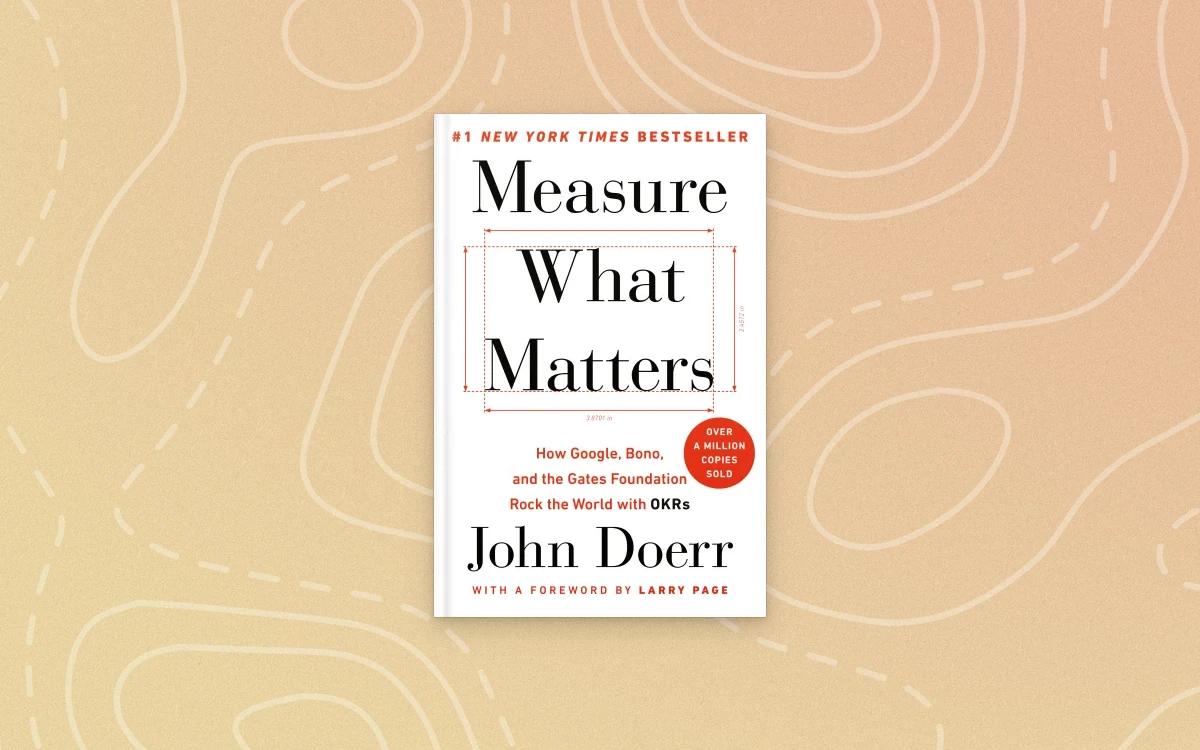
Measure What Matters by John Doerr is the book that carried Objectives and Key Results out of Intel and Google and into everyone else's planning cycle. This summary distills the book's core insights into the eight ideas you can actually run a quarter on, plus an honest account of where the book leaves you on your own.
About Measure What Matters
John Doerr is an engineer turned venture capitalist and the chairman of Kleiner Perkins, where he has backed founders for roughly 37 years. He was an original investor and board member at both Google and Amazon. Before any of that he was a salesman and manager at Intel under Andy Grove, which is where he learned OKRs firsthand rather than from a textbook.
Published by Portfolio in 2018, the book is a sustained argument against the goal-setting most companies inherited from mid-century Management by Objectives: targets set once a year, handed down without consent, tied to a bonus, and reviewed in a backward-looking annual appraisal.
Doerr's diagnosis is organizational fuzziness. Teams work hard on things nobody agreed mattered, priorities quietly conflict, and at year end nobody can say whether a goal was hit. His counter-proposal is deliberately small: a transparent, quarterly, measurable goal system that anyone in the company can read.
The book became a number one New York Times bestseller, opened with a foreword by Google cofounder Larry Page, and carried jacket endorsements from Bill Gates, Sheryl Sandberg, and Jim Collins. It is now the default first book handed to a team about to adopt OKRs, which is exactly why it is worth reading critically rather than reverently.
Key takeaways
The eight takeaways below follow the shape of the book itself: the thesis, the anatomy of an OKR, the four superpowers that make up Part One, the continuous performance management argument of Part Two, and the caveat Doerr closes on.
1. Ideas are cheap, execution is scarce
Doerr pitched OKRs to a roughly 40-person Google in 1999 with a claim that sounds almost insulting to founders: the quality of an idea rarely decides who wins. Two companies can hold the same insight, and the one that ships it is the one that made the insight concrete, assigned it, measured it, and looked at it again the following week.
That framing carries the whole book. A goal system is not administrative overhead layered on top of the work, it is the mechanism that converts an intention into an output somebody can point at.
Doerr did not invent the discipline. He learned it from Andy Grove at Intel, whose complaint about the alternative Doerr returns to repeatedly: enormous effort, very little achieved. Grove's fix was to measure output rather than activity, on a quarterly clock, in public.
The practical version of the thesis is a chain, and the book's remaining chapters are each one link in it: an idea becomes an objective, the objective gets key results, the key results get checked weekly, the quarter gets scored, and the score feeds the next objective.
2. Key results must carry a number
The most useful operational rule in the book is that objectives are qualitative and key results are quantitative, and that the split is a test rather than a matter of style. An objective is allowed to sound inspirational precisely because the key results underneath it are not.
Doerr's formula is one line: I will (objective) as measured by (this set of key results). The objective is what is to be achieved, no more than that. Key results benchmark and monitor how you get there, and they have to survive a yes or no reading at quarter end with no judgment involved.
Property | Objective | Key result |
|---|---|---|
Question it answers | What is to be achieved | How you know you got there |
Character | Significant, concrete, action oriented, ideally inspirational | Specific, time-bound, aggressive yet realistic |
Form | Qualitative, a sentence | Quantitative, measurable and verifiable |
Lifespan | Can roll over for a year or longer | Evolves as the work progresses |
How many | Three to five per cycle | Three to five per objective |
Doerr credits the sharpest statement of the rule to a former colleague at Google.
The cap of three to five matters as much as the number itself. A key result list that runs to twelve items has stopped being a definition of success and become a task list with a due date.
3. Focus means saying no to good ideas
Superpower number one in the book is Focus and Commit to Priorities, and its practical rule is a hard cap: three to five objectives per cycle, chosen by explicitly declining everything else.
The failure mode Doerr names is not laziness, it is ambition. Leaders publish fifteen priorities and thereby publish none, because a team facing fifteen equally weighted goals will simply pick the ones it already wanted to do.
What focus actually requires
- Cap the cycle at three to five objectives. Anything beyond that is a wish list, not a commitment.
- Publish the non-goals. Teams need explicit permission to stop work, not just direction on what to start.
- Give every objective a named owner. Shared accountability with no name attached decays into nobody's accountability.
- Explain the why, not only the what. A list of milestones motivates nobody; people need to see how the goal connects to the mission.
Doerr's phrase for the resource consequence is to put more wood behind fewer arrows. The distinction he keeps drawing is between what matters and what is merely urgent, and only leadership can draw it, because only leadership can absorb the cost of the things that get dropped.
4. Publish every goal, including the CEO's
The second superpower, Align and Connect for Teamwork, rests on a structural choice most companies never make: every OKR in the company is visible to every employee, from the newest hire's up to the CEO's.
Transparency turns alignment from an annual cascade into something people do for themselves. Anyone can see which goal their work ladders into, and anyone can spot two teams solving the same problem in parallel. The book leans on a blunt statistic here, that only about 7 percent of employees fully understand their company's business strategy and what is expected of them.
Doerr pairs the transparency rule with a participation rule. Roughly half of a team's OKRs should originate bottom-up and be negotiated with the manager rather than dictated, and his argument for it is motivational rather than democratic: people finish what they helped choose.
Dimension | Cascaded goals | Connected goals |
|---|---|---|
Direction | Top-down only | Roughly half negotiated bottom-up |
Speed | Slow, each layer waits for the one above | Fast, teams draft in parallel |
Visibility | Your manager's goals, if you ask | Every goal in the company, by default |
Coupling | One-directional, brittle when priorities shift | Many-to-many, re-linked mid-cycle |
Failure mode | Meaning is lost at every handoff | Duplication, visible early enough to fix |
5. Goals nobody tracks quietly die
The third superpower, Track for Accountability, is the book's answer to the fire-and-forget annual goal. An OKR is a living document, not a filing. It gets scored continuously, reviewed on a regular cadence, and closed out with an explicit grade rather than allowed to expire.
The failure mode Doerr names is the zombie OKR: a goal still on paper, still nominally owned, and devoid of any life or meaning. Tracking prevents it only if the check-in is allowed to change the goal, which is why the book gives four legitimate mid-cycle moves:
- Continue: the goal is on track and the plan holds
- Update: the target or the timeline moves to reflect what you learned
- Start: a new OKR enters mid-cycle because reality changed
- Stop: a goal that no longer serves the mission is retired, on purpose and in public
Close-out matters as much as the cadence. Score the result on a 0.0 to 1.0 scale, judge that score subjectively rather than mechanically, then answer four questions: did I hit the objective, what contributed, what got in the way, and what would I write differently tomorrow.
6. Set the goals you expect to miss
The fourth superpower, Stretch for Amazing, is the one that separates OKRs from every safe target-setting system. Doerr's argument is causal rather than motivational: a target calibrated to be reachable calibrates the work to be incremental, so the only reliable way to get a step change is to write a goal that makes the current approach obviously insufficient.
Google's convention is to split goals in two. Committed OKRs are operational (sales, hiring, launch dates) and are expected in full. Aspirational OKRs are the moonshots, where 70 percent is a good outcome and a 40 percent average failure rate is normal rather than alarming.
The 0.7 convention
On an aspirational OKR, a score of 0.7 is the target, not a shortfall. Scoring 1.0 consistently is read as a sign the goal was set too low, and a miss on a committed OKR is the one that triggers a post-mortem. Mixing the two types in one list without labelling them is the fastest way to make the convention meaningless, which is why the committed versus aspirational split has to be declared when the goal is written, not argued about when it is scored.
Doerr backs the claim with goal-setting research rather than folklore, citing evidence that around 90 percent of field experiments confirm productivity rises with well-defined, challenging goals. Larry Page's calibration test in the book is more useful than any formula: aim for a goal that makes the team uncomfortably excited.
7. Replace annual reviews with continuous conversations
Part Two of the book argues that OKRs on their own are a scoreboard with no coach. The missing half is continuous performance management, which Doerr packages as CFRs: conversations, feedback, and recognition.
Conversations are the structured exchange between a manager and a contributor aimed at driving performance. Feedback is peer-to-peer and networked rather than routed through a hierarchy. Recognition is appreciation for contributions of any size, given by anyone. Together they run at the tempo of the work instead of once a year in a room with a form.
The most consequential prescription in the book is also the least followed: keep OKR scores out of the compensation formula. Doerr's reasoning is mechanical, not sentimental. The moment a goal decides a bonus, people negotiate for goals they can hit, and the stretch target from takeaway 6 becomes impossible to ask for.
Dimension | Annual performance review | CFRs |
|---|---|---|
Frequency | Once a year | Continuous, weekly or fortnightly |
Direction of view | Backward, over twelve months of memory | Forward, over the current cycle |
Flow | Manager to report | Networked, including peer to peer |
Link to pay | Directly tied, often ranked | Deliberately decoupled |
What it produces | A rating | A correction, while it still matters |
8. OKRs will not fix a broken culture
The book closes on its own limits, and this is the takeaway most OKR sales pitches drop.
Doerr argues the causality runs both ways. Transparent goals expose a culture and can gradually change it, but a culture of blame will turn the same transparency into a surveillance tool within one quarter. His framing of the difference: a rule book bounds what you may do, culture tells you what you should do.
The preconditions worth checking before a rollout are unglamorous:
- Truth-telling about numbers. If a red status is career-limiting, every check-in will be green and the system reports nothing.
- Tolerated failure on stretch goals. A 0.6 has to be survivable, or nobody sets an aspirational OKR twice.
- Decoupling from pay. Covered in takeaway 7, and the one most organizations quietly skip.
- Leaders who go first. Executive OKRs published before anyone else's is the cheapest credibility signal available.
Where those conditions are missing, the honest sequence in the book is values first and goals second, which is slower and far less satisfying than rolling out a template.
Measure What Matters book review and limitations
Measure What Matters holds a 3.97 rating on Goodreads from over 38,000 readers, which is respectable but noticeably below what its sales and endorsements would predict. It reached number one on the New York Times bestseller list, but no newspaper or business magazine review of the book could be verified for this summary, so its praise comes from named endorsers instead: Larry Page, who wrote the foreword, credits OKRs with "10x growth, many times over." However, reviewers have noted several limitations.
The framework is thin and the case studies are thick: The method itself occupies a small fraction of the page count, and the rest is company profiles written in a promotional register. A reader who wants the mechanics gets them in the first third and then reads two hundred pages of confirmation.
The rollout mechanics are missing: Reviewers routinely finish the book without knowing what a review cadence looks like in practice, how to handle the first bad quarter, or what to do when a team games the scoring. OKR coach Felipe Castro audited the key results printed in the book itself and found that more than half of them contain no number at all, and that only a handful measure an outcome rather than an activity, which means the examples fail the test the book spends chapters establishing. Its advice to separate goals from compensation also arrives with no guidance for the many organizations that have already linked them.
It contradicts itself on shared and cascaded goals: The book argues for cross-functional collaboration and connected goals in one place and treats co-ownership as a threat to accountability in another. It similarly recommends adopting OKRs company-wide while also endorsing pilots, leaving anyone planning a rollout with two incompatible instructions.
Every organization profiled is a survivor: The case set is Google, YouTube, Intuit, Adobe, the Gates Foundation, and a run of well-capitalized startups, with no failure cases to balance them. That selection makes it impossible to tell whether OKRs caused the outcomes or merely accompanied companies that had unusual talent density and capital to begin with.
Who should read this book?
Measure What Matters lands best with founders, CEOs, and senior leaders at companies of roughly 30 to 500 people, past the point where everyone hears the strategy in one room and choosing a goal system for the first time.
HR and People leaders get the strongest argument in print for retiring the annual performance review, and internal OKR champions get the case studies a skeptical board actually responds to. You will walk away with the origin story, the rationale, and the vocabulary, which is what buy-in is made of.
It lands less well with practitioners who already run OKRs and need cadence, scoring edge cases, and rollout sequencing, and with anyone in a low-trust or heavily compliance-driven organization, since the book's core assumptions of transparency, decoupled pay, and tolerated failure are stated as given rather than as things you have to build.
Related reading
Mooncamp resources
- How to Write OKRs: Turning Doerr's formula into objectives and key results that survive a quarter
- OKR Scoring: Grading on the 0.0 to 1.0 scale and what the 0.7 convention actually means
- OKRs and CFRs: Conversations, feedback, and recognition, the Part Two half of the book
- Best OKR Books: Where this title sits in the wider OKR reading list
Related books
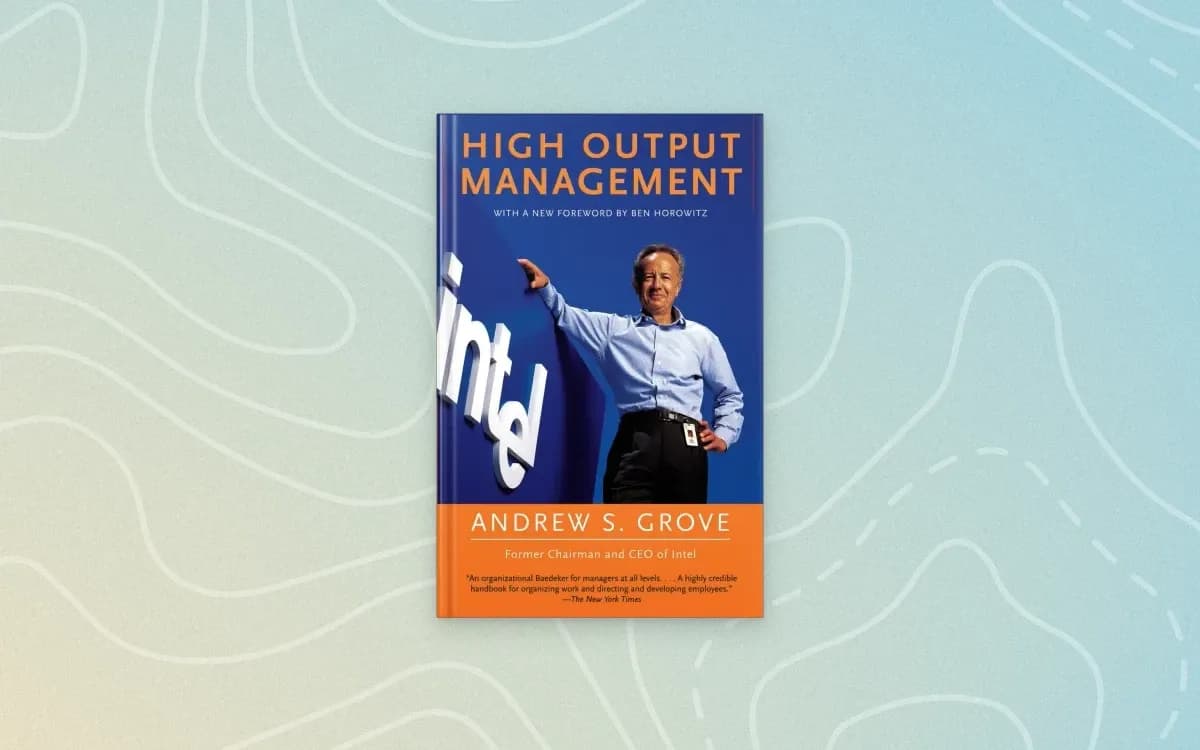
- High Output Management by Andy Grove: The source text Doerr learned from at Intel, and the operating theory he popularized
- Radical Focus by Christina Wodtke: The implementation book Measure What Matters is criticized for not being, with a concrete weekly cadence
- Objectives and Key Results by Paul Niven and Ben Lamorte: The consultants' handbook, covering rollout sequencing and how OKRs sit alongside KPIs
- Good Strategy Bad Strategy by Richard Rumelt: The upstream question Doerr never asks, which is whether your objectives are the right ones