What is strategic planning?
Strategic planning is the organizational operating system used to define a long-term direction, make distinct choices about where to play and how to win, and allocate resources to pursue that strategy. It transforms abstract ambition into a concrete roadmap.
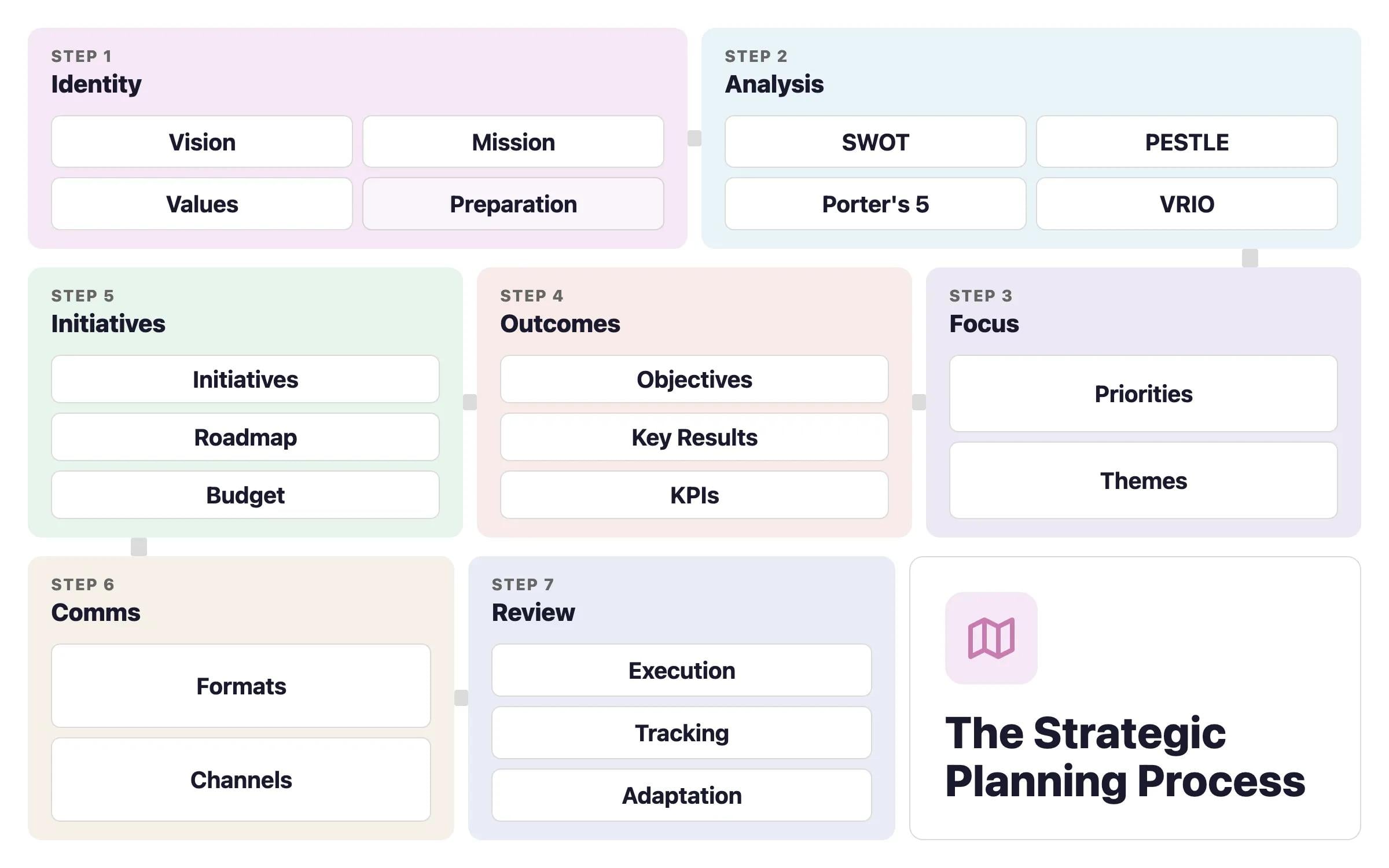
The 7 steps of the strategic planning process:
- Establish your core identity – Define your Vision, Mission, and Values.
- Analyze the strategic landscape – Map the internal and external terrain.
- Determine critical focus areas – Make the hard choices on where to focus.
- Set measurable outcomes – Translate focus into concrete OKRs and KPIs.
- Map out initiatives – Plan the specific actions to bridge the gap.
- Create and communicate the plan – Mobilize the team with a shared narrative.
- Execute, review, and adapt – Implement, learn, and iterate.
What is the strategic planning process?
At its core, the strategic planning process is about solving a problem. It is the process of diagnosing your organization's biggest challenges and designing a coherent approach to overcome them.
Many treat strategic planning as an annual ritual, a calendar event where executives retreat to an offsite, produce a 100-page slide deck, and then return to "business as usual." This is a recipe for failure.
True strategic planning is a continuous cycle. It connects your highest ambitions (Vision) with the daily work on the ground (Tasks). It answers three simple but profound questions:
- Where are we now? (Diagnosis)
- Where do we want to be? (Vision & Objectives)
- How will we get there? (Strategy & Execution)
The 7 steps of the strategic planning process
While every organization is unique, the anatomy of a good strategic planning process is universal. Below is a 7-step framework that moves from abstract identity to concrete action.
Step 1: Establish your core identity
Strategic planning starts with identity. Before you decide what to do, you must agree on who you are. If the foundation is shaky, the house will fall.
- Vision Statement: Your "North Star." A vivid description of the future you want to build (e.g., "To organize the world's information").
- Mission Statement: Your daily purpose. What you do, who you serve, and why it matters right now.
- Core Values: The non-negotiable behaviors that guide how you work. Real values require trade-offs (e.g., prioritizing "Safety" over "Speed").
Component | Description |
|---|---|
Inputs | Founder intent, market thesis, employee surveys. |
Activities | Leadership workshops, stakeholder interviews, culture audit. |
Outputs | Finalized Vision, Mission, and Values statements. |
Owners | CEO, Executive Team, Head of Strategy. |
Timebox | 2–4 weeks (if starting from scratch). |
- Is the vision aspirational yet achievable?
- Does the mission clarify what we do and why?
- Are values actionable behaviors, not just nice-to-have words?
⚠️ Anti-pattern: treating this as a "copywriting exercise." If your values don't force you to make trade-offs (e.g., choosing "Speed" over "Perfection"), they aren't strategy; they are just marketing.
Step 2: Analyze the strategic landscape
You cannot navigate without a map. This step of the strategic planning process is about gathering objective data to understand your playing field. It requires looking both in the mirror (Internal) and out the window (External).
Common frameworks used in strategic planning include:
- SWOT Analysis: Strengths, Weaknesses, Opportunities, Threats.
- PESTLE Analysis: Political, Economic, Social, Technological, Legal, Environmental factors.
- VRIO Analysis: Value, Rarity, Imitability, Organization.
- Porter's Five Forces: Analysis of competitive pressure.
The Inside-Out vs. Outside-In Tension
In his book "Strategy: Process, Content, Context," Bob de Wit emphasizes balancing two perspectives: "Outside-In" (market-driven opportunities) and "Inside-Out" (your unique capabilities). The tension between what the market wants and what you are uniquely good at is where strategy is born. Don't just chase market trends, leverage what makes you different.
Component | Description |
|---|---|
Inputs | Financial data, customer feedback, competitor reports, market trends. |
Activities | SWOT workshop, PESTLE research, VRIO assessment, competitor analysis. |
Outputs | Strategic Factbase, SWOT/PESTLE/VRIO summary decks. |
Owners | Strategy Team, Department Heads. |
Timebox | 2–3 weeks. |
- Have we looked at competitors and substitutes?
- Have we been honest about our internal weaknesses?
- Is the data current (less than 6 months old)?
⚠️ Anti-pattern: "Analysis Paralysis." Teams keep collecting data until the strategy feels "risk‑free," but the real risk is delaying decisions while competitors move. Define in advance which 3–5 questions the analysis must answer, then decide when that threshold is met.
Step 3: Determine critical focus areas
Strategic planning is the art of sacrifice. You cannot win everywhere. Based on your strategic landscape analysis, you must identify the 3–5 critical battles you must win to achieve your vision.
Use prioritization frameworks like RICE (Reach, Impact, Confidence, Effort) or ICE to rank potential themes.
The Kernel Check
In "Good Strategy / Bad Strategy," Richard Rumelt introduces the concept of a Kernel Check. Before setting priorities, ask: Do you have a clear Diagnosis of the challenge? Your priorities should not just be a list of wishes; they should be a direct response to the specific hurdles identified in Step 2. A good strategy solves a specific problem, not a general aspiration.
Component | Description |
|---|---|
Inputs | SWOT/PESTLE findings, Vision/Mission. |
Activities | Prioritization offsite, risk heatmap exercise, "Keep/Kill/Combine" session. |
Outputs | 3–5 Strategic Pillars or Themes. |
Owners | Executive Team. |
Timebox | 1–2 days (intensive workshop). |
- Are there fewer than 5 priorities?
- Do they directly address the SWOT analysis?
- Are they distinct from "business as usual" operations?
⚠️ Anti-pattern: "Peanut Buttering." Spreading resources thinly across too many priorities, ensuring none of them succeed.
Step 4: Set measurable outcomes
Strategic priorities are just words until they are measured. In this step of the strategic planning process, you must translate your qualitative themes into quantitative targets.
We recommend using OKRs (Objectives and Key Results) for this stage of strategic planning. OKRs are the bridge between strategy and execution:
- Objectives: Qualitative, inspirational goals (Where do we want to go?)
- Key Results: Quantitative, measurable outcomes (How will we know we arrived?)
- KPIs: Health metrics to monitor business-as-usual performance.
Component | Description |
|---|---|
Inputs | Strategic Pillars (from Step 3), baseline metric data |
Activities | Drafting annual Company OKRs, aligning with finance on targets |
Outputs | Annual Company OKRs, Top-level KPI Dashboard |
Owners | Executive Team, OKR Champions |
Timebox | 2 weeks |
- Do we have a mix of leading and lagging indicators?
- Are the Key Results value-based (outcomes) or just task lists (outputs)?
- Does every goal have a clear owner?
⚠️ Anti-pattern: "Confusing Output with Outcome." Setting goals like "Launch new website" (a task) instead of "Increase conversion by 15%" (a value-based result). If you complete the project but the metrics don't move, the strategy has failed. Focus on the impact, not the activity.
Step 5: Map out initiatives
Now that you have the destination (Goals), you need the route (Strategy). How exactly will you achieve those Key Results?
This involves defining the initiatives, the specific projects and programs your teams will execute as part of your strategic plan.
The Strategic Choice Cascade
In "Playing to Win," Roger Martin and A.G. Lafley introduce the Strategic Choice Cascade, a framework that forces you to make explicit choices:
- Winning Aspiration: (Covered in Step 1)
- Where to Play: Which markets, customers, channels?
- How to Win: What is our competitive advantage (cost vs. differentiation)?
- Capabilities: What must we be able to do?
- Management Systems: How will we track it?
This framework ensures your Guiding Policy (the approach) leads to Coherent Actions (the initiatives).
Component | Description |
|---|---|
Inputs | Annual OKRs, Budget constraints |
Activities | Initiative planning, resource allocation, budgeting |
Outputs | Strategic Roadmap, Initiative Backlog, Budget Plan |
Owners | Department Heads, Project Managers |
Timebox | 2–4 weeks |
- Do we have the budget and people to execute these initiatives?
- Do the initiatives clearly link to a Key Result?
- Have we identified dependencies between teams?
⚠️ Anti-pattern: The "Wishlist." Approving more projects than you have capacity for. This leads to burnout and slippage.
Step 6: Create and communicate the plan
A strategy that lives in the CEO's head is not a strategy; it's a secret. To mobilize the organization, you must package the results of your strategic planning into a compelling narrative.
Format options:
- One-Page Strategic Plan (OGSM): Objectives, Goals, Strategies, Measures on a single sheet.
- Strategy Map: Visualizing cause-and-effect relationships.
- Strategy Deck: A polished presentation for town halls.
Component | Description |
|---|---|
Inputs | All outputs from Steps 1–5 |
Activities | Writing, design, Town Hall presentation, department roadshows |
Outputs | The Strategic Plan document, Communication Plan |
Owners | CEO, Internal Comms |
Timebox | 1 week |
- Can an employee explain the top 3 priorities in their own words?
- Is the plan accessible (e.g., on the intranet or OKR software)?
- Have we explained "what's in it for me" to the teams?
⚠️ Anti-pattern: "Launch and Leave." Announcing the strategy once and never mentioning it again. Strategy requires over-communication.
Step 7: Execute, review, and adapt
This is where most organizations fail. They treat the strategic planning process as a document to be filed away, rather than a dynamic strategy operating system.
To close the execution gap, you need a strategy process that runs continuously, not just once a year:
- Review performance against OKRs and KPIs.
- Check if the hypotheses from Step 2 are still valid.
- Adapt initiatives and resource allocation for the next quarter.
Deliberate vs. Emergent Strategy
In "Strategy: Process, Content, Context," Bob de Wit distinguishes between Deliberate (planned) strategy and Emergent (opportunistic) strategy. The best strategic planning process balances both: you set a deliberate course, but remain open to emerging opportunities or threats. If a new competitor appears, your plan must flex to meet the threat, this is not a failure of planning, but a success of strategic agility.
Component | Description |
|---|---|
Inputs | Performance data, updated market signals |
Activities | Weekly check-ins, Monthly operating reviews, Quarterly Business Reviews (QBRs) |
Outputs | Updated forecasts, Revised OKRs for next quarter |
Owners | All Leaders, Strategy Operations |
Timebox | Ongoing (Quarterly cycle) |
- Do we have a fixed calendar for strategy reviews?
- Are we using software (like Mooncamp) to track progress in real-time?
- Are we honest about failures and learning from them?
⚠️ Anti-pattern: "Set and Forget." Looking at the goals only at the end of the year. Course correction is impossible if you don't check the compass.
Strategic planning frameworks: when to use which
There is no "one size fits all" framework. The right tool depends on your organization's size, maturity, and specific challenges. Below is a comparison of the most effective strategic planning frameworks.
Framework | Primary Use Case | Pros | Cons |
|---|---|---|---|
Balanced Scorecard (BSC) | Holistic performance management across financial, customer, process, and learning dimensions. | Connects financials with customer, process, and learning goals. | Can become bureaucratic and heavy on reporting. |
OKRs (Objectives & Key Results) | Driving focus, clarity, and measurable execution toward strategic outcomes. | Extremely adaptable; focuses on outcomes, not tasks. | Requires cultural shift; often confused with KPIs. |
Hoshin Kanri | Translating long-term strategy into disciplined annual plans with tight alignment. | Excellent vertical alignment (Catchball); rigorous. | Rigid; difficult to change mid-cycle. |
OGSM | Creating a concise, one-page strategy that links goals, strategies, and measures. | Fits on one page; clear cascade from Goal to Measure. | Can lack the "how" (execution details); less flexible. |
Strategic Choice Cascade | Defining a sharp, principle-based strategic direction through explicit trade-offs. | Forces tough trade-off decisions (Where to Play). | Strategic only; needs a separate system for execution. |
Three Horizons | Balancing core operations with mid-term innovation and long-term growth bets. | Great for visualizing innovation pipelines. | Abstract; hard to operationalize into daily work. |
VRIO Analysis | Evaluating internal capabilities to identify sustainable competitive advantages. | Identifies true competitive advantages. | Internally focused; ignores market dynamics. |
Ansoff Matrix | Structuring growth decisions based on product/market expansion paths. | Simple visual for risk vs. growth decisions. | Too simplistic for complex multi-product strategies. |
Porter's Five Forces | Understanding competitive pressures and industry structure to inform strategy. | Deep insight into competitive landscape. | Static snapshot; misses dynamic ecosystem changes. |
PESTLE | Assessing external macro factors that impact strategy, risks, and opportunities. | Comprehensive external risk assessment. | Can lead to information overload without action. |
Strategic plan template
After completing the 7 steps, you need to package everything into a document people can actually use. This template shows how to fit your entire strategic plan on one page, organized into four sections: context & identity, core strategy, execution roadmap, and management system.
Fill it in with your Vision, Mission, SWOT/PESTLE findings, strategic priorities, OKRs, initiatives, and review cadence.
Best practices for strategic planning
Even with the best frameworks, the process is what determines success. Based on our experience with thousands of teams using Mooncamp for strategic planning, here are the non-negotiable best practices.
1. Keep it flexible (Continuous Strategy)
The days of the 5-year strategic plan carved in stone are over. Adopt an agile approach where you set a long-term vision but review the roadmap quarterly. If the market shifts (e.g., a new AI breakthrough), your plan must be able to pivot quickly, not next year.
2. Involve diverse stakeholders
Strategic planning shouldn't be built in an ivory tower by the C-suite alone.
- Top-down: Leaders set the Vision and Strategic Priorities.
- Bottom-up: Teams propose the Initiatives and Key Results to achieve them. This "Catchball" process ensures buy-in. People support what they help create.
3. Document the "Why", not just the "What"
When documenting your strategic plan, include the context. Why did we choose Priority A over Priority B? What assumptions are we making about the market? Documenting your hypothesis allows you to learn later. If you fail, you want to know if it was bad execution or a bad strategy.
4. Make data-driven decisions
Don't rely on "HiPPO" (Highest Paid Person's Opinion). Use your environmental scan data to inform your strategic planning.
- Before planning: Use churn data, market reports, and employee sentiment.
- During execution: Use real-time dashboards to monitor leading indicators, not just financial reports that come weeks too late.
5. Align culture with strategy
As Peter Drucker famously said, "Culture eats strategy for breakfast." If your strategic planning requires innovation but your culture punishes failure, the strategy will fail. Explicitly map out the behaviors (Values) needed to execute the plan.
6. Leverage AI for synthesis
Modern strategic planning processes can be accelerated with AI. Use LLMs to:
- Summarize vast amounts of customer feedback for your SWOT.
- Challenge your strategy by playing "Devil's Advocate."
- Draft OKRs based on your strategic themes to save time.
7. Close the feedback loop
The most critical best practice in the strategic planning process is the review cadence. A strategy is a hypothesis; execution is the experiment. You must regularly review the results of the experiment to validate the hypothesis. If you don't close the loop, you aren't learning, you're just guessing.
Common pitfalls and how to avoid them
Even smart teams fall into trap. Here are the most common reasons strategic plans fail and how to prevent them during your strategic planning process.
Pitfall | The Fix |
|---|---|
Static Annual Planning Creating a plan in January and ignoring it until December. | Adopt a continuous strategy cadence. Review progress quarterly. If the map doesn't match the terrain, change the map. |
Too Many Priorities Trying to fix everything at once (e.g., 10+ priorities). | Ruthless Prioritization. Cap strategic themes at 3–5. Use frameworks like RICE to force trade-offs. |
Fluffy Goals "Improve customer service" (Subjective). | Measurable Outcomes. Use OKRs. "Increase CSAT from 80 to 90" (Objective and verifiable). |
The "Air Sandwich" A disconnect between the Vision (Top) and the Day-to-day (Bottom). | Cascade Goals. Ensure every team Key Result links up to a Company Objective. Verify dependencies. |
Budget Disconnect Approving a strategy but not funding the initiatives required to build it. | Put Your Money Where Your Strategy Is. Review budget allocation alongside strategy every quarter. |
Failure to Face the Problem A strategy that looks like a wish list and ignores the root challenge. | Kernel Check. Start with a brutally honest diagnosis of the obstacles. A good strategy solves a problem. |
Next steps and resources
Strategic planning is a journey, not a destination. The best way to start your strategic planning process is to simply start, gather your team, ask the hard questions, and write down your hypothesis.
To help you turn your plan into action, explore these resources:
- Strategic Planning Software Guide: A comparison of the best tools to manage your strategy.
- OKR Guide: The complete guide to Objectives and Key Results. Learn how to bridge the gap between strategy and execution.
Ready to close the execution gap? Mooncamp is the strategic planning software that keeps your strategy front and center throughout the year.