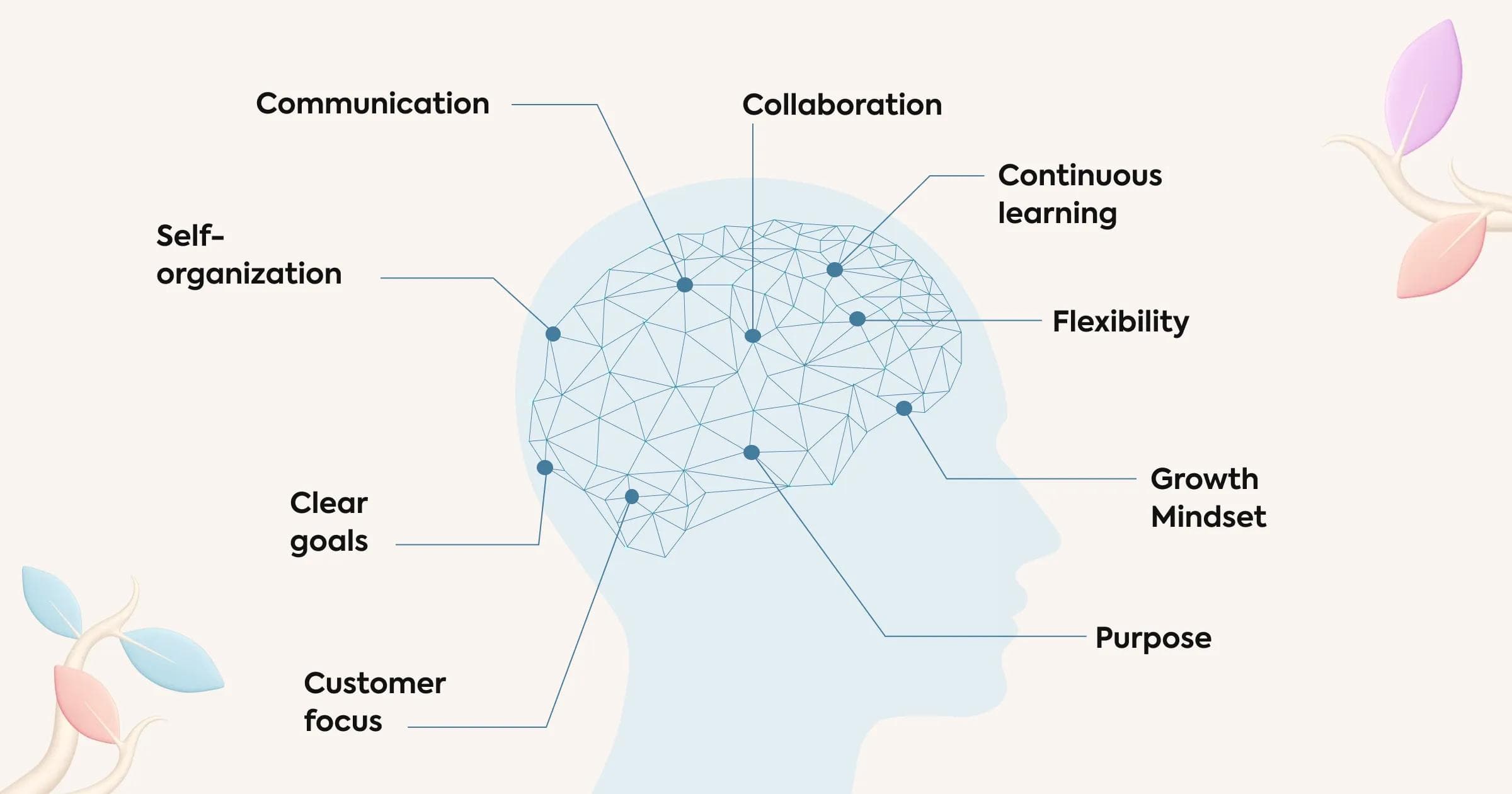
- Startups are experiments, not small companies: A startup is defined by extreme uncertainty rather than by size or sector, so the tools built for stable operating histories do not apply.
- Build, measure and learn, planned in reverse: Plan the loop backwards from what you need to learn, then run it forwards, minimizing total time round the cycle.
- Measure validated learning, not features shipped: Progress means demonstrating empirically that you learned something true about customers, so a team can hit every delivery commitment and advance nothing.
- Build the smallest thing that produces an answer: A minimum viable product exists to start the learning, so any work beyond what that required is waste.
- Decide to pivot or persevere on a schedule: A pivot tests a new fundamental hypothesis while keeping what was validated, and the real danger is deferring the decision.
- Know which engine your growth runs on: Sustainable growth runs on one of three engines, sticky, viral or paid, and each makes a different number the one that matters.
- Work in small batches so problems surface early: Small batches surface defects while they are still cheap to fix, which is why single piece flow beats batching on feedback.
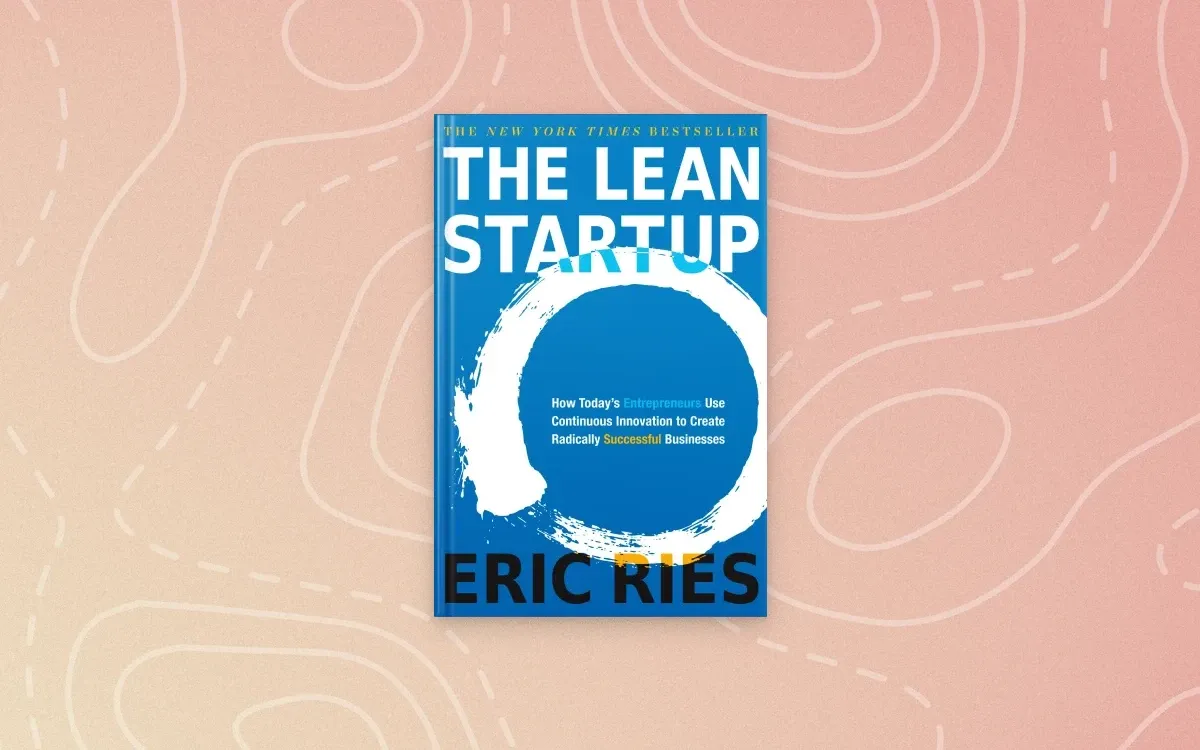
The Lean Startup by Eric Ries argues that a startup is an experiment run under extreme uncertainty, so its unit of progress has to be validated learning rather than features delivered on time. This summary distills the book's core insights into seven takeaways you can apply to how your own team plans, measures and decides.
About The Lean Startup
Eric Ries cofounded the avatar-based social network IMVU in 2004 and served as its CTO. He coined the term "Lean Startup" on his blog Startup Lessons Learned in September 2008, three years before the book, and has been unusually candid that the method came out of his own failures rather than his successes.
He was an entrepreneur-in-residence at Harvard Business School, IDEO and Pivotal, went on to write The Startup Way in 2017 about running the same method inside large organizations, and founded the Long-Term Stock Exchange, which the SEC approved as a national securities exchange in 2019.
Published in September 2011 by Crown Currency, an imprint of Penguin Random House, the book reacts against two opposite failure modes at once. One is the romantic theory that startup success comes from genius, timing or luck and therefore cannot be taught. The other is the corporate product playbook of long incubation, a detailed plan and a market forecast, which Ries says produces "achieving failure": teams that execute flawlessly and build something nobody wants.
His counterclaim is that entrepreneurship is a form of management with its own discipline, and that the discipline is a scientific loop rather than a better plan. The book's own origin story is that Ries studied the Toyota Production System after IMVU's early struggles and asked what lean manufacturing would look like applied to innovation.
The Lean Startup was a New York Times bestseller and the publisher reports more than a million copies sold and translations into more than thirty languages. Its vocabulary of MVPs, pivots and vanity metrics is now so widely used that most teams inherit it secondhand, which is exactly why the original repays a read. For where lean sits alongside its neighbors, see our overview of agile methods.
Key takeaways
The following seven takeaways carry the transferable arguments in The Lean Startup. Each one moves from a claim about how startups make progress to something you can change in how your team measures and decides.
The five principles of the Lean Startup, in the book's own order
- Entrepreneurs are everywhere: you do not have to work in a garage to be in a startup, and the approach works in any size company and any sector.
- Entrepreneurship is management: a startup is an institution, not just a product, so it needs a kind of management geared to extreme uncertainty.
- Validated learning: startups exist to learn how to build a sustainable business, and that learning has to be demonstrated with real data.
- Build, measure, learn: turn ideas into products, measure how customers respond, then learn whether to pivot or persevere.
- Innovation accounting: to hold innovators accountable, focus on the boring stuff of measuring progress, setting milestones and prioritizing work.
1. Startups are experiments, not small companies
Ries opens by redefining the noun. A startup is not defined by size, industry, funding or garage aesthetics, but by the condition it operates in.
He is explicit that "the most important part of this definition is what it omits. It says nothing about size of the company, the industry, or the sector of the economy." That omission is deliberate, because it lets the definition cover a team inside a company with thousands of employees.
The book's showcase case is therefore not a garage. It is SnapTax, built inside Intuit, where the uncertainty was not technical but whether anyone would file taxes from a photo of a form.
Case in the book | Not a garage startup | What made it a startup anyway |
|---|---|---|
SnapTax | Intuit, 7,700 employees, revenues in the billions | Nobody knew whether people would file taxes from a phone photo |
Village Laundry Service | Backed by Innosight Ventures and run by an eight-year P&G veteran | Nobody knew whether people would hand over laundry to a stranger and pay |
Kodak Gallery | A division of a hundred-year-old company | Nobody knew which customer problem the feature actually solved |
The practical consequence is that the standard management toolkit is the wrong toolkit. Forecasts, milestones and detailed plans all assume a stable operating history, and a startup by this definition does not have one.
For anyone running quarterly goals, the sting is worth stating plainly. A confident forecast attached to an unproven product is not rigor, it is a category error about what kind of thing you are running.
2. Build, measure and learn, planned in reverse
The Build-Measure-Learn loop is the book's engine, and Ries is precise about a detail most summaries drop: the loop is planned backwards even though it runs forwards.
You start from what you need to learn, work out which measurement would tell you, and only then decide the smallest thing you can build to produce that measurement.
Each stage of the loop has an artifact, and naming them is what keeps the loop from becoming a slogan:
- Ideas to Build. The output is a minimum viable product, sized by what you need to learn rather than by what feels finished.
- Product to Measure. The output is data, which has to be actionable, accessible and auditable or it is a vanity metric.
- Data to Learn. The output is validated learning, and the decision it forces is pivot or persevere.
- The thing being optimized is total time through the whole loop, not throughput at any one stage.
That last point is the one teams get wrong. Speeding up the build step alone buys nothing if the measurement takes six weeks to arrive, which is why the loop is a cadence rather than a development practice.
The lineage is older than the book admits in passing. Build, measure, learn is a descendant of the PDCA cycle, the plan, do, check, act loop Deming took to Japan, applied to product discovery instead of process quality.
Ries's competitive claim underneath all of this is blunt: "The only way to win is to learn faster than anyone else." A head start, in his reading, is rarely large enough to matter.
3. Measure validated learning, not features shipped
This is the takeaway with the most direct transfer to anyone running goals. Ries argues that a team's unit of progress has to change: not features delivered, not tasks completed, not the plan hit on time and on budget, but whether the team learned something true it did not know before.
He fences the word off from its usual abuse immediately, because "we learned a lot" is the standard alibi for a quarter that produced nothing.
The test he gives for whether a number is worth reporting is the three A's, and each one catches a different way of fooling yourself.
Test | What it demands | The failure it catches |
|---|---|---|
Actionable | The report demonstrates clear cause and effect | A number that goes up without anyone knowing why |
Accessible | Everyone judged by the report can read and check it | Metrics that live inside one analyst's spreadsheet |
Auditable | The data can be tested by hand, by talking to real customers | Numbers nobody can trace back to a person |
His name for what fails all three is the vanity metric: gross totals, cumulative registered users, raw page hits. "Vanity metrics wreak havoc because they prey on a weakness of the human mind", he writes, since a cumulative total can only ever go up.
The replacement is cohort analysis, looking at each group of customers who arrived in a given period on its own terms, so a flat conversion rate stays visible instead of being buried under accumulated totals.
The uncomfortable corollary is that a team can deliver every committed feature and have made no progress at all. That is the same distinction as outputs versus outcomes in goal setting, arriving from the product side rather than the goal side.
4. Build the smallest thing that produces an answer
The minimum viable product is the book's most borrowed and most misused idea, and Ries defines it against the misuse. An MVP is not the smallest product imaginable and not a prototype, it is the fastest route through one complete loop.
He is equally clear about its job. In his words, "the goal of the MVP is to begin the process of learning, not end it", which means an MVP that answers nothing is just a small product.
The examples are deliberately chosen so that several of them are not products at all. Each one answered a single question that no amount of internal debate could have settled:
- Dropbox shipped a demo video of a product that did not yet work, and the beta waiting list went from 5,000 to 75,000 people overnight.
- Food on the Table ran a concierge service by hand for a handful of customers, to find out whether anyone would pay for a weekly meal plan built from grocery deals.
- Village Laundry Service put a consumer washing machine on the back of a pickup truck for under $8,000, to find out whether people would hand over laundry and pay.
- Zappos photographed shoes in a local store and bought them at retail whenever an order arrived, to find out whether customers were ready to buy shoes online.
Ries's rule for what to cut is harsher than most teams apply. Any work beyond what was required to start learning is waste, however important it seemed at the time it was planned.
The examples are chosen to make one point about definitions. An MVP is defined by the question it answers, not by how much of it exists.
5. Decide to pivot or persevere on a schedule
The pivot is the book's decision procedure, and Ries treats indecision rather than failure as the real danger. His definition is narrower than the popular one: "A pivot is a special kind of change designed to test a new fundamental hypothesis about the product, business model, and engine of growth."
The word "special" is load-bearing. A pivot keeps one foot planted, retaining what has already been validated, which is what separates it from starting over.
Innovation accounting is what makes the decision answerable rather than emotional. You establish a baseline with an MVP, tune the engine toward the ideal, and then look at whether the tuning is working, which is the pivot or persevere question in numeric form.
Ries recommends putting that meeting on the calendar at a fixed cadence rather than waiting for a crisis, precisely because the conversation is expensive and will otherwise be deferred forever. Teams that already run a regular OKR check-in have the meeting slot; what they usually lack is permission to change the hypothesis inside it.
Five of the ten pivots in the book's catalog
- Zoom-in pivot: what was a single feature becomes the whole product.
- Zoom-out pivot: what was the whole product becomes a single feature of something larger.
- Customer segment pivot: the product solves a real problem, but for a different customer than planned.
- Customer need pivot: the customer is right, the problem turns out not to matter enough, and a related problem does.
- Engine of growth pivot: the growth model changes, for example from viral to paid. This is the one Ries had to make at IMVU.
There are ten in all, the others being platform, business architecture, value capture, channel and technology. Naming them matters because a team that can only say "we are changing direction" has no way to argue about which direction.
The warning attached is the book's sharpest passage, and it is aimed at perseverance rather than at failure.
6. Know which engine your growth runs on
Ries argues that sustainable growth follows exactly one of three engines, and that a team's metrics only become meaningful once it knows which one it is on.
The point is not taxonomy. Each engine makes a different number the governing one, so a team optimizing for the wrong number can improve everything it measures while growth stays flat.
The sticky engine is governed by churn: growth happens when the rate of new customer acquisition exceeds the rate at which existing customers leave, and the speed of compounding is simply the difference between the two. The viral engine is governed by the viral coefficient, which counts how many new customers each new customer brings, and anything above 1.0 compounds. The paid engine is governed by the margin between what a customer is worth and what they cost to acquire.
Engine | What teams get wrong about it |
|---|---|
Sticky | Celebrating cumulative registered users while churn quietly eats the base |
Viral | Treating word of mouth as a campaign to run rather than a property of the product |
Paid | Buying growth that is not profitable and reporting it as traction |
Ries uses his own failure as the case. IMVU was built on the assumption that it would grow virally through existing instant-messaging networks, customers refused to use it that way, and the company had to execute an engine of growth pivot.
7. Work in small batches so problems surface early
Part Three of the book stops being about startups and becomes about how teams work, and its central mechanic is batch size. Ries borrows single piece flow from lean manufacturing and argues, against everyone's intuition, that finishing one unit end to end beats doing every unit's first step and then every unit's second step.
The reason is feedback rather than throughput. A small batch tells you something is wrong while it is still cheap to fix, and a large batch tells you at the end.
Why small batches win, in the book's terms
- Problems appear while the batch is still small enough to fix cheaply.
- Nobody has to guess at the end whether the whole run is defective.
- Rework is bounded by the batch rather than by the whole plan.
- The team learns its real cycle time instead of its planned one.
- Quality cannot be traded for time, because defects created now slow you down later.
The paired practice is the Five Whys: ask why five times to trace a symptom down to its root cause, then make a proportionate investment in prevention at each level. Ries's claim is that this is how a team speeds up without accumulating bureaucracy, because the investment is sized to the symptom rather than to the fear.
What makes the practice work is a cultural rule rather than a technical one, and it is the line readers quote back most often.
Without that rule, the exercise degrades into a hunt for whoever is at fault, and the team learns to hide defects rather than to trace them.
The Lean Startup book review and limitations
The Lean Startup holds a 4.11 rating on Goodreads from over 370,000 readers. Marc Andreessen's blurb reads "Eric has created a science where previously there was only art", and Jeffrey Immelt, then CEO of General Electric, is quoted on the publisher's page saying "I make all our managers read The Lean Startup." However, reviewers have noted several limitations.
The evidence is case studies selected after the fact: The book asks readers to run Popperian experiments and then argues for that discipline with a sequence of narratives about companies that had already succeeded, including the author's own. A method whose proof is a list of winners cannot show you what it would look like for the method to be wrong.
It certifies success with venture funding and acquisition offers: When the text needs to establish that a case study worked, it reaches for money raised or offers received, which is exactly the kind of cumulative, non-causal number its own metrics chapter tells you to distrust.
The method optimizes for what is cheap to observe: In a Long Range Planning essay, Teppo Felin, Alfonso Gambardella, Scott Stern and Todd Zenger argue that the emphasis on readily observable feedback undersells the entrepreneur's central task of composing a novel theory worth testing. Their conclusion is that lean startup "promotes incremental experiments that, more often than not, only generate incremental value", a point Peter Thiel makes from the other direction in Zero to One when he says iteration finds local maxima rather than new things.
Almost every example is software: IMVU, Dropbox, Grockit, Votizen, Wealthfront and SnapTax can all be changed daily, and the cadence the book assumes is simply not available in regulated industries, hardware, biotech or anything with a physical supply chain. Ries offers Village Laundry Service as a counterexample, but such cases are a small minority of the book.
Who should read this book?
The Lean Startup is for product managers, founders and engineering or product leaders in teams of roughly 5 to 200 who are building something whose demand is genuinely unproven and who can ship and measure inside a week. It lands hardest on anyone who has just watched a well-executed roadmap deliver a product nobody adopted.
It is also unusually useful for innovation and new-venture leads inside large companies, since Ries wrote Part Three for exactly that reader and Intuit and General Electric are among the cases. For a goals audience, the natural reader is whoever owns a quarterly objective whose key results currently count outputs.
It lands less well where demand is already known and a long operating history makes classical planning work. Readers who want rigorous evidence will be disappointed, and anyone who absorbed the vocabulary secondhand will find the first third repetitive: the parts that reward a full read are innovation accounting, the engines of growth and the small-batch material at the end.
Related reading
Mooncamp resources
- Zero to One Book Summary: Thiel's counter-argument that iteration finds local maxima rather than breakthroughs
- OKRs and Agile: How a learning cadence and a goal cadence fit together in the same quarter
- OKR Mistakes: The vanity metric problem as it shows up inside a goal system
- Best OKR Books: Where this book sits in the wider goal-setting and execution bookshelf
Related books
- Zero to One by Peter Thiel: The direct rebuttal, arguing that leanness is a methodology rather than a goal
- The Startup Owner's Manual by Steve Blank and Bob Dorf: Customer development, the ancestor of this method, with the step-by-step process critics say Ries left out
- The Startup Way by Eric Ries: The author's own sequel, taking the same method into large organizations with a governance layer
- Crossing the Chasm by Geoffrey Moore: The early-adopter model behind Ries's insistence on finding the customers who feel the problem most acutely