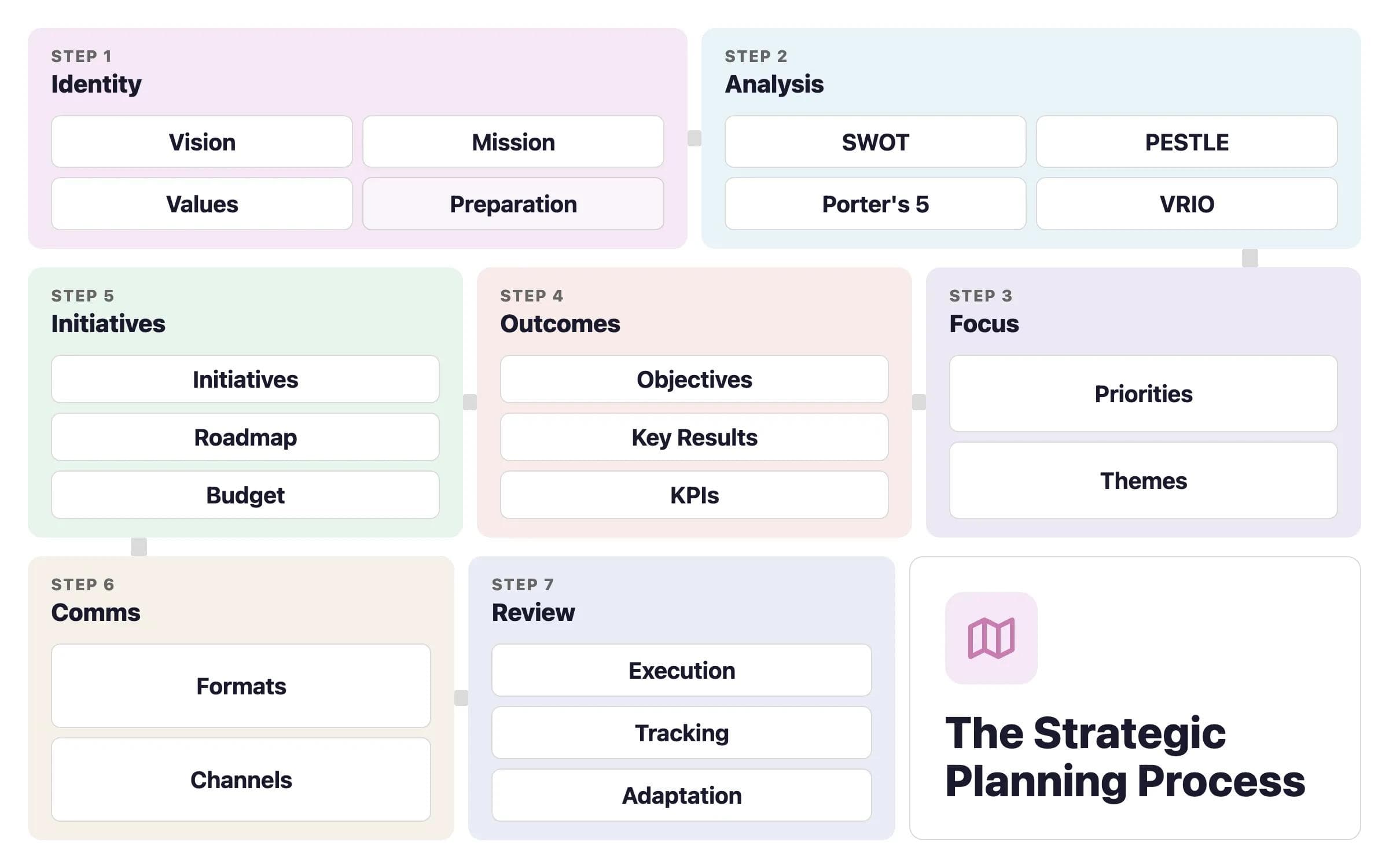
- Copying takes the world from 1 to n: Horizontal progress copies what already works, while vertical progress creates something that did not exist, and only the second builds new value.
- Competition is an ideology, not a virtue: Perfect competition drives profit to zero, so rivalry is a cultural habit absorbed at school rather than evidence of a valuable market.
- Start small and monopolize, then scale: Own a market small enough to dominate outright, then expand into adjacent markets, because moving first matters less than moving last.
- Durable positions rest on four advantages: Proprietary technology, network effects, economies of scale and branding are what keep a market position defensible ten years out.
- Definite plans beat indefinite optionality: Expecting a better future without planning it produces process instead of substance, so hold a specific view and work backwards from it.
- Results follow a power law, so concentrate: A small handful of bets outperform everything else combined, which makes diversification a way of owning none of them.
- Every great business is built on a secret: A secret is something important, unknown and findable, sitting between conventions everyone already knows and mysteries nobody can solve.
- Distribution decides, not the product: Superior distribution can build a monopoly with no product differentiation, but a superior product with no distribution plan cannot.
- Answer all seven questions before you commit: Engineering, timing, monopoly, people, distribution, durability and secret form the checklist that separates a business from a hope.
Zero to One: Notes on Startups, or How to Build the Future by Peter Thiel with Blake Masters argues that valuable companies are built by doing something nobody has done before, not by doing something familiar slightly better. This summary distills the book's core insights into nine takeaways you can apply to your own market choices and strategic planning.
About Zero to One
Peter Thiel co-founded PayPal in 1998 and served as its CEO before the 2002 IPO, made the first outside investment in Facebook in 2004, and co-founded Palantir Technologies. As a partner at Founders Fund he backed SpaceX and Airbnb, and he created the Thiel Fellowship, which pays young people to skip college and build companies.
Blake Masters was a Stanford law student in Thiel's 2012 CS183 startup course at Stanford. The detailed lecture notes he posted online circulated far beyond campus and became the raw material the two of them revised into this book.
Published in 2014 by Crown, an imprint of Penguin Random House, the 224-page book reacts against the defensive dogmas the dot-com crash left behind: make incremental advances, stay lean and flexible, improve on the competition, focus on product rather than sales. Thiel's counterclaim is that competition destroys profit and monopoly creates it, so a company's real job is to find a small market it can own outright and expand from there. He aims the same criticism at the wider culture, which he says expects the future to improve while refusing to say how.
Zero to One was a #1 New York Times bestseller and a 2014 Goodreads Choice Awards nominee in business books, and its vocabulary of monopoly, secrets and last movers has since been absorbed into how startups talk about strategy. For the goal-setting literature this book never touches, see our roundup of the best OKR books.
Key takeaways
The following nine takeaways carry the transferable arguments in Zero to One. Each one moves from a claim about how value is created to a decision you can actually make about your own market.
1. Copying takes the world from 1 to n
The title is the whole argument compressed. Doing more of something that already exists is horizontal progress, the safe and legible and copyable kind. Making something that did not exist before is vertical progress, and it is the only kind that creates new value.
Thiel's opening move is to point out that the successful companies everyone studies were not built by studying successful companies. The next Bill Gates will not build an operating system, and the next Mark Zuckerberg will not build a social network.
Because every act of creation is singular, there is no repeatable formula for it. That is why the book refuses to be a recipe and trains a habit of mind instead: the contrarian question Thiel says he asks in job interviews.
The book's definition of technology is deliberately broad. Any new and better way of doing things counts, which means a company inside a mature industry can still make vertical progress by changing how the work is done rather than by shipping a gadget.
2. Competition is an ideology, not a virtue
Thiel's most-quoted inversion is that competition and capitalism are opposites. Capitalism is about accumulating capital, and under perfect competition all profits are competed away.
His explanation for why nobody sees this is that competition is not really an economic position at all. It is a cultural one, absorbed through school, where grades rank you against people doing identical work, and reinforced by professional hierarchies where the prize for winning is a narrower fight against a smaller pool.
The practical damage is that competitive framing distorts judgment. It makes people imitate rivals, fight over things that do not matter, and mistake rivalry itself for evidence that something valuable is at stake. This is the same conclusion blue ocean strategy reaches from the opposite direction: escaping the contest beats winning it.
US airlines in 2012 | Google in 2012 |
|---|---|
Hundreds of billions of dollars of value created | $50 billion in revenue |
Average one-way fare of $178 | 21 percent of it kept as profit |
37 cents of profit per passenger trip | More than 100 times the airline industry's margin that year |
Thiel also notes that both sides lie about which one they are. Monopolists describe their market as vast to avoid scrutiny, and competitors describe theirs as tiny and unique to look defensible, so the way a company sizes its own market tells you which position it is really in.
3. Start small and monopolize, then scale
Having argued that monopoly is the goal, the book gives its only real sequencing advice. Pick a market small enough that you can own all of it, own it, then expand outward in concentric circles into adjacent markets you have earned the right to enter.
This is why a large addressable market in a pitch deck reads to Thiel as a warning rather than a selling point. He calls it a red flag when entrepreneurs talk about getting one percent of a $100 billion market, because one percent of anything is a position nobody is defending.
The same logic produces his inversion of first mover advantage. What matters is not entering a market first but making the last significant advance in it, after which the market stops changing hands.
First mover versus last mover
First mover | Last mover |
|---|---|
Enters the market before anyone else | Makes the last great development in the market |
Optimizes for early market share | Optimizes for future cash flows |
A tactic | A goal |
Can be unseated by whoever arrives next | Enjoys years or even decades of monopoly profits |
The book's worked cases are all the same shape. Amazon started with books before moving to CDs, videos and software; eBay started with Beanie Baby collectors; PayPal started with roughly 20,000 eBay PowerSellers and cracked that segment after three months of dedicated effort; Facebook started with Harvard students.
4. Durable positions rest on four advantages
Owning a market this quarter is not the same as owning it in a decade. The book's test for the difference is qualitative rather than numeric: will this business still be here in ten years, and what specifically stops someone from taking it?
Thiel names four characteristics that durable monopolies tend to share, and he is explicit that they are diagnostic rather than prescriptive. Checking the boxes does not produce a monopoly, and the book says so directly.
The most demanding of the four is proprietary technology, where the bar is an order of magnitude rather than a percentage. That is the same 10x rather than 10 percent instinct behind a moonshot goal, applied to product rather than to targets.
The other three carry their own constraints. Network effects only pay off if the product is already valuable to its very first users, which is precisely why network businesses have to start in tiny markets. Economies of scale reward software, where the marginal cost of another copy is close to zero, and punish service businesses. Branding is real but derivative, and the book is blunt that no technology company can be built on branding alone.
Apple is the integrated case: a visible brand held up by invisible proprietary technology, manufacturing scale and app-ecosystem network effects. That combination is what strategic positioning looks like when it survives contact with a decade of competitors.
5. Definite plans beat indefinite optionality
This is the chapter with the most direct transfer to how organizations set goals. Thiel's claim is that the dominant Western posture is indefinite optimism: a belief that things will improve combined with a refusal to say how.
In practice that shows up as process replacing substance, resume-building replacing commitment, and iteration replacing product vision. He is explicit that this is a choice rather than a condition, and that the alternative is to hold a specific view of the future and work backwards from it.
The four views of the future, in the book's own order
- Indefinite pessimism: a bleak future with no idea what to do about it. The book's example is Europe since the early 1970s.
- Definite pessimism: the future can be known and it will be bleak, so prepare for it. The book's example is China.
- Definite optimism: the future will be better if you plan and work to make it better. The book's example is mid-century America.
- Indefinite optimism: the future will be better but you do not know how, so you make no specific plans. The book's example is the United States since 1982.
The evidence for definite optimism is a list of things that got finished. The Empire State Building started in 1929 and finished in 1931. The Golden Gate Bridge started in 1933 and was completed in 1937. The Manhattan Project began in 1941 and had produced the first nuclear bomb by 1945. The Interstate Highway System broke ground in 1956 and had its first 20,000 miles open for driving by 1965. Apollo began in 1961 and put twelve men on the moon before it finished in 1972.
The corporate consequence is worth stating plainly: a good definite plan is systematically underpriced in a world that treats the future as random. If your strategic planning process produces a portfolio of options rather than a specific claim about what the world will look like, it is producing indefinite optimism with a template around it.
6. Results follow a power law, so concentrate
Outcomes in venture, and by extension in careers and portfolios of any kind, are not normally distributed. A very small number of bets produce more return than all the others combined.
Thiel reports his own fund's numbers as the proof. Facebook, the best investment in Founders Fund's 2005 fund, returned more than all the others combined, and Palantir, the second best, is set to return more than the sum of every other investment aside from Facebook.
The consequence is uncomfortable for anyone who treats spread as prudence. Diversification does not reduce your exposure to the few things that matter, it guarantees you own none of them in any meaningful size, and the named anti-pattern of spraying and praying usually produces a portfolio of flops with no hits at all.
He extends the argument past investors, arguing that everyone allocates time, career and attention, and that life is not a portfolio. This is the chapter to hand anyone defending a list of fifteen company priorities, even though the book never uses the vocabulary of goal-setting.
7. Every great business is built on a secret
The business version of the contrarian question is what valuable company is nobody building. Thiel's claim is that every correct answer is a secret: something important and unknown, hard to do but doable.
He separates three categories of knowledge, and only one of them is worth chasing:
- Conventions: things everyone already knows, which by definition cannot give you an edge
- Secrets: things that are hard but possible to find out, which is where companies come from
- Mysteries: things that may be impossible to know at all, which is where startups go to die
Most people behave as though there are no secrets left. Thiel blames four habits for that, and he names them in order: incrementalism, risk aversion, complacency, and what he calls flatness, the assumption that in a globalized world any findable insight would already have been found.
The two search directions he gives are concrete. Ask what secrets nature is not telling you, and ask what secrets people are not telling you. Airbnb, Lyft and Uber all came from the second kind, spotting spare capacity that was sitting in plain sight.
8. Distribution decides, not the product
Chapter 11 attacks the engineer's belief that a good enough product sells itself, and states the asymmetry bluntly. Strong distribution with an undifferentiated product can build a monopoly. A strong product with no distribution plan cannot.
Thiel's explanation for why technical people resist this is that sales works best when it is invisible. The better a salesperson is, the less the work looks like selling, which makes the whole discipline read as fake to people who value legible technical effort.
The structural idea underneath is that distribution methods sit on a continuum set by two numbers, customer lifetime value and customer acquisition cost. The methods that work at one deal size are uneconomic at another, which is the part most go-to-market strategy work gets wrong.
Method | What it looks like | Example |
|---|---|---|
Complex sales | Average sale of seven figures or more, where every deal needs the CEO | SpaceX selling to NASA |
Personal sales | Deals between $10,000 and $100,000, moved by a sales team of modest size | Box |
Distribution doldrums | A dead zone around $1,000 a year where neither salespeople nor advertising pays | A tool sold to small businesses |
Marketing and advertising | Low-priced products with mass appeal and no viral mechanism | P&G detergent |
Viral marketing | Core functionality encourages users to invite their friends | PayPal, Facebook |
The doldrums are the interesting entry, because they are a gap rather than a method. A product priced around $1,000 a year is too cheap to justify a salesperson and too expensive to sell on advertising alone, and companies stuck there usually mistake a distribution problem for a product problem.
9. Answer all seven questions before you commit
The book's only checklist arrives late, and it arrives as a post-mortem rather than a template. Thiel introduces the seven questions to explain why the 2000s cleantech bubble produced so many spectacular failures, arguing that most of those companies answered none of them well and were therefore hoping for a miracle rather than running a business.
The scoring rule is deliberately unforgiving. Nail all seven and you succeed, five or six might work, and a company with no good answers will attribute its collapse to bad luck.
More than 40 solar manufacturers went out of business or filed for bankruptcy in 2012 alone, while executives boasted about trillion-dollar energy markets without noticing that huge markets mean ruthless competition. Tesla is the counter-example from the same sector and the same era, and the book scores it against the same seven.
How Tesla answered all seven
Question | Tesla's answer as the book scores it |
|---|---|
Engineering | Technology good enough that other carmakers license it |
Timing | A one-time $465 million Department of Energy loan secured in January 2010 |
Monopoly | Started with about 3,000 Roadsters at $109,000 each, then took the luxury electric sedan market |
People | Musk as both the engineer and the salesman |
Distribution | Owns its entire distribution chain instead of using dealers |
Durability | A head start plus a widening lead |
Secret | Cleantech was a social phenomenon, so people buy an electric car as a statement about themselves |
Zero to One book review and limitations
Zero to One holds a 4.14 rating on Goodreads from over 416,000 readers. Writing in The Atlantic, Derek Thompson said the book "shines like a laser beam" against a fog of fuzzy-headed nonsense. However, reviewers have noted several limitations.
It repackages conventional wisdom as contrarianism: Several reviewers argue that ordinary advice is made to sound heretical by setting it against caricatured positions almost nobody actually holds. Once the framing is stripped away, a fair amount of the book turns out to be standard startup counsel in a bolder voice.
It is a polemic dressed as a handbook: The book announces early that there is no formula and then keeps that promise, so a reader looking for a method leaves with an argument instead. There are no templates, no exercises and no processes anywhere in its 224 pages.
The monopoly claim is overstated: Plenty of companies have earned billions in openly competitive markets, which the book's central thesis has to treat as an anomaly. The related premise that a last mover holds its position permanently has aged badly, since several of the 2014 monopolies held up as permanent have since faced exactly the displacement the framework says should not happen.
The philosophy is weaker than the business advice: The startup mechanics are sharp and specific, while the chapters on education, culture and stagnation trade in much broader assertions. The anti-education stance is also self-undermining, since the book's own erudition is obvious evidence of a deep formal education at work. You can read the Publishers Weekly review for a fuller version of the practical objection.
Who should read this book?
Zero to One is for people whose live question is which market we should be in and what makes our position defensible, rather than how we hit this quarter. That means founders and CEOs at early-stage companies, heads of product and strategy at any size, and corporate development or new-ventures leads who need an argument against incrementalism they can put in front of a board.
You walk away with a vocabulary for market selection: the 10x bar, the four monopoly characteristics, the last-mover question, and the seven-question checklist to run a plan through before committing to it. It also reads well at a leadership offsite, because the arguments are short, sharp and built to be disagreed with.
It lands less well for operators looking for a playbook, and it is close to useless for anyone running a service business, an agency, a regulated business or a mature category where a monopoly position is neither achievable nor legal. The book has nothing to say about the gap between a definite plan and delivered results, so pair it with a real strategy execution approach rather than treating it as one.
Related reading
Mooncamp resources
- Playing to Win Book Summary: The same market-selection choice framed as a cascade rather than a checklist
- Strategy Execution: How to turn a definite plan into delivered results
- Strategic Positioning: What makes a market position defensible over time
- Blue Ocean Strategy: Escaping competition through uncontested market space
Related books
- Good Strategy Bad Strategy by Richard Rumelt: Supplies the diagnosis, guiding policy and coherent action that a definite plan actually needs
- Blue Ocean Strategy by W. Chan Kim and Renée Mauborgne: Reaches the same escape-competition conclusion through market-boundary analysis and value curves
- The Innovator's Dilemma by Clayton Christensen: The disruption argument Thiel is pushing back on when he tells founders not to disrupt
- Measure What Matters by John Doerr: Covers the goal-setting mechanics that Zero to One deliberately leaves out