- Level 5 leaders combine humility with will: Every company that made the leap was run by someone self-effacing in public and relentlessly ambitious for the institution rather than themselves.
- Get the right people on before choosing direction: The transitions started with personnel decisions, not with a new vision, because the right people adapt when the destination changes.
- Confront the brutal facts, keep the faith: Greatness required an unflinching account of current reality alongside absolute confidence of prevailing, a pairing Collins names the Stockdale Paradox.
- Find the one thing three circles share: A Hedgehog Concept sits where what you can be best at, what drives your economics and what you love overlap.
- Discipline replaces hierarchy, bureaucracy and controls: Disciplined people remove the need for hierarchy, disciplined thought removes bureaucracy, and disciplined action removes most of the control apparatus.
- Technology accelerates momentum, it never creates it: The great companies pioneered technology only where it served the one thing they had already decided to be best at.
- Turn the flywheel, do not launch programs: No transformation had a launch event or a name, because momentum accumulated through visible results rather than through announcements.
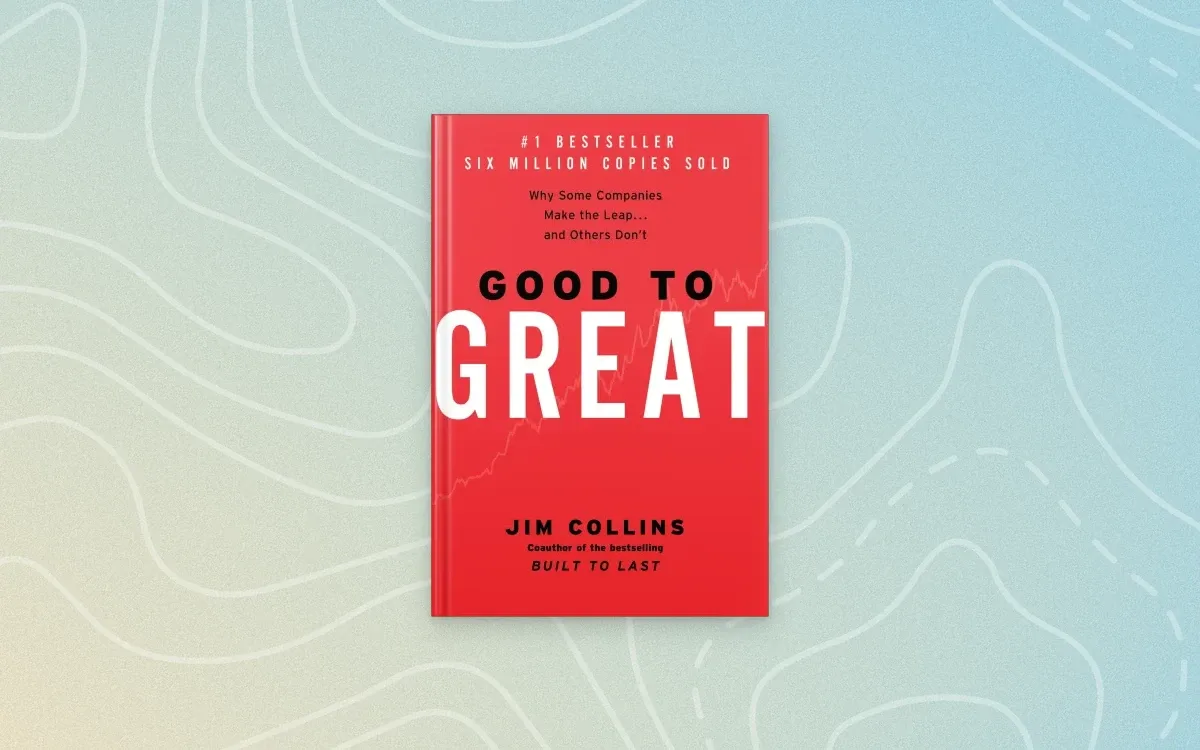
Good to Great: Why Some Companies Make the Leap... and Others Don't by Jim Collins reports what a five-year study found when it compared 11 companies that sustained a leap in performance against a matched set that never did. This summary distills the book's core insights into seven takeaways you can apply to how your own organization picks people, sets goals and builds momentum.
About Good to Great
Jim Collins is a researcher and writer on company performance who has run his own management laboratory in Boulder, Colorado, since 1995. He holds a degree in mathematical sciences and an MBA from Stanford, taught at the Stanford Graduate School of Business where he received the Distinguished Teaching Award in 1992, and held the Class of 1951 Chair for the Study of Leadership at West Point in 2012 and 2013.
Forbes named him one of the 100 Greatest Living Business Minds in 2017. He is co-author of Built to Last with Jerry I. Porras, and he presents Good to Great as the study that answers a question the earlier book raised but never resolved: how a company that is merely good becomes one worth building to last.
Published in October 2001 by HarperBusiness, the book reacts against the belief that dramatic corporate results require dramatic corporate process. Collins lines up the usual candidates and rejects each one: the change program, the burning platform, stock options, fear-driven change, acquisitions, technology bets and revolution. His opening premise inverts the standard diagnosis, because the obstacle to greatness is not failure, it is being good enough to stop.
The study began with the 1,435 companies that appeared on the Fortune rankings for 1965, 1975, 1985 and 1995. A company qualified only if it matched or trailed the general market for 15 years, then hit a transition point, then returned at least three times the market over the following 15 years, and only if the shift was specific to the company rather than to its whole industry. Eleven companies survived, each paired with a direct comparison company, and the 11 averaged 6.9 times the general market across their post-transition decade and a half.
The book sat on BusinessWeek's best-seller list from release according to a 2008 academic review of its record, and TIME later included it in its list of the 25 most influential business management books. Wikipedia's article on the book puts sales at four million copies, and a 2008 paper in Academy of Management Perspectives opened with a figure of more than 4.5 million. For the goal-setting mechanics this book deliberately leaves out, see our roundup of the best OKR books.
Key takeaways
The following seven takeaways are the concepts that cleared Collins's own bar for inclusion: each appeared in 100 percent of the good-to-great companies during the pivotal transition years and in fewer than 30 percent of the matched comparisons. Together they run in sequence as disciplined people, disciplined thought and disciplined action, with the flywheel wrapped around the whole framework.
1. Level 5 leaders combine humility with will
Collins did not go looking for a leadership finding. He instructed his research teams to downplay the role of top executives so the study would not collapse into another credit-the-CEO story, and the teams argued back until the data forced the finding in.
What they found was the opposite of the celebrity chief executive. Level 5 leaders were self-effacing, quiet and reserved, and they were also utterly intolerant of mediocrity.
The pattern is a duality rather than a personality type, which is why it is easy to miss on first reading. Ambition is present in full measure, but it is pointed at the institution instead of at the person holding the job.
The two sides of Level 5 leadership
Personal humility | Professional will |
|---|---|
Shows a compelling modesty and shuns public adulation | Creates superb results and is a clear catalyst in the transition |
Relies on inspired standards rather than inspiring charisma | Holds an unwavering resolve to do whatever must be done |
Channels ambition into the company rather than the self | Sets the standard of building an enduring great company |
Looks out the window to apportion credit for success | Looks in the mirror to apportion responsibility for poor results |
The window and the mirror is the behavioral tell, and it is the one a colleague can observe without any access to the research. Level 5 leaders look out the window to assign credit and into the mirror to assign responsibility, while the comparison executives reliably did the reverse.
Darwin Smith is the case Collins uses to make the type concrete. The mild-mannered in-house lawyer became chief executive of Kimberly-Clark in 1971, sold the paper mills including the one in the company's namesake town, and produced cumulative returns 4.1 times the general market across 20 years.
More than two-thirds of the comparison companies had executives with outsized egos that Collins ties to their decline or continued mediocrity. Rubbermaid's Stanley Gault answered the charge that he was a tyrant by conceding he was a sincere one, and in one article on leading change used the word "I" 44 times against 16 uses of "we".
2. Get the right people on before choosing direction
This finding ran directly against what Collins expected. He assumed the transitions would begin with a new vision and a new strategy, and instead they began with personnel.
The image he uses is a bus. The good-to-great leaders got the right people on it, the wrong people off it, and the right people into the right seats, and only then worked out where to drive.
Starting with what | Starting with who |
|---|---|
People board for the destination and leave when it moves | People board for the company and adapt when it moves |
Motivation becomes a permanent management problem | Self-motivated people make the motivation problem mostly disappear |
The right direction with the wrong people still fails | The right people often find a better direction than yours |
Strategy is set first and then staffed | The team is assembled first and then points itself |
David Maxwell took over Fannie Mae in 1981 while it was losing a million dollars every business day. The board wanted to know what he would do about the mortgage book, and he told them that was the wrong first question.
He interviewed every member of his management team, told them the ride would be demanding, and offered a clean exit to anyone who wanted one. Fourteen of 26 executives left the bus, and by the end of his tenure the company was earning four million dollars a day. (Fannie Mae's later collapse is one of the limitations discussed below, and the turnaround should be read as a moment rather than a durable outcome.)
The sequencing runs against how most planning cycles work, which is the uncomfortable part for anyone who owns one. A vision statement written before the team exists commits you to recruiting toward a fixed destination, and that is precisely the order Collins found the good-to-great companies reversing.
3. Confront the brutal facts, keep the faith
Collins pairs two things most leaders treat as alternatives. The good-to-great companies hit adversity at the same rate as their comparisons, and what separated them was holding an unflinching account of their situation alongside an absolute conviction that they would prevail.
He names the pairing after Admiral Jim Stockdale, the highest-ranking American officer held in the Hanoi Hilton prisoner-of-war camp, who was tortured more than twenty times across eight years of imprisonment. The detail Collins draws out is that the optimists did not survive: the men who kept setting a release date were broken by each Christmas that passed.
The practical translation is a design problem rather than a values statement. Leaders cannot decree that bad news travels upward, so Collins gives four mechanisms that build a climate where the truth is actually heard.
Four practices for creating a climate where the truth is heard
- Lead with questions, not answers: Alan Wurtzel of Circuit City answered a direct question about where he would take the company by saying he did not know.
- Engage in dialogue and debate, not coercion: Nucor's strategy evolved through arguments and fights rather than through a decision announced from the top.
- Conduct autopsies, without blame: Philip Morris devoted five pages of a chief executive's memoir to dissecting the failed 7UP acquisition.
- Build red flag mechanisms: Graniterock let any customer unilaterally deduct from an invoice whatever they were not satisfied with, so dissatisfaction could not be filtered on the way up.
The claim that lands hardest on goal programs is that time spent motivating people is largely wasted. The real job is to avoid de-motivating them, and Collins names false hope as one of the most de-motivating things a leader can offer.
Charisma turns out to be a liability on this dimension. A leadership personality strong enough to fill a room is also strong enough to deter people from carrying inconvenient facts into it.
4. Find the one thing three circles share
The Hedgehog Concept is the book's answer to strategy, and it is deliberately austere. Collins borrows Isaiah Berlin's parable, in which the fox knows many things while the hedgehog knows one big thing, and argues that the good-to-great leaders were all hedgehogs.
The concept is defined as the intersection of three circles, and the discipline is that all three have to be true at once. Two out of three is a business, not a Hedgehog Concept.
The first circle is the demanding one, because it makes a comparative claim about the world rather than a claim about your own competence. Collins is explicit that a core business you cannot be the best in the world at cannot form the basis of a great company, no matter how long you have been running it.
The economic circle carries a mechanic that most summaries skip. Each company found the single denominator, profit per some unit, that moved its economics more than any other, and then organized around improving it.
Company | Economic circle it reorganized around |
|---|---|
Walgreens | Profit per customer visit, replacing profit per store |
Wells Fargo | Profit per employee, replacing profit per loan |
Kimberly-Clark | Consumer brand economics, after exiting the paper mills |
Walgreens then built clustered, convenient stores because that is what a per-visit denominator rewards, and Wells Fargo abandoned the ambition to be a global bank after concluding it would never be the best one. This is what a single organizing key performance indicator looks like when it is chosen from a strategic position rather than inherited from a reporting template.
The concept did not come out of a workshop. Collins found it took the good-to-great companies four years on average to crystallize theirs, through an iterative loop of piercing questions, vigorous debate, resolute action and autopsies without blame.
5. Discipline replaces hierarchy, bureaucracy and controls
Collins's argument here is structural rather than motivational. Bureaucracy exists to compensate for the wrong people and for undisciplined thinking, so an organization that has already solved those two problems no longer needs most of its control apparatus.
The chapter is built as a three-part substitution, and each half of the trade is specific. Disciplined people remove the need for hierarchy, disciplined thought removes the need for bureaucracy, and disciplined action removes the need for excessive controls.
What building a culture of discipline requires
- Freedom and responsibility within a framework: The model is an airline pilot, who has full authority inside a rigidly defined system.
- Self-disciplined people who go to extreme lengths: The people already inside the culture do the last unglamorous increment without being asked.
- No confusion with a tyrannical disciplinarian: Discipline imposed by one strong personality leaves with that personality, as Rubbermaid demonstrated.
- Almost religious consistency with the Hedgehog Concept: Anything falling outside the three circles gets systematically unplugged.
The image Collins uses for the second point is Dave Scott, the six-time Hawaii Ironman winner who rinsed the fat off his cottage cheese while burning 5,000 calories a day in training. The point is not the diet, it is that nobody made him do it and no marginal gain was beneath him.
The most usable artifact in the chapter is the stop-doing list. Collins says the good-to-great companies made as much use of stop-doing lists as of to-do lists, which is a genuine test of whether a strategic planning process has made a choice or merely added another row.
6. Technology accelerates momentum, it never creates it
This is not a rejection of technology, and reading it that way inverts the finding. The good-to-great companies were pioneers in applying carefully selected technologies, and they also refused to let technology be the thing that started a transformation.
The discriminator is the Hedgehog Concept. A technology earns pioneering investment only if it directly serves the one thing the company has already decided it can be best in the world at, and anything else gets parity at most, which makes the adoption decision downstream of a strategic decision rather than a substitute for one.
Technology as igniter | Technology as accelerator |
|---|---|
Adopted because rivals are adopting it | Adopted because it serves the Hedgehog Concept |
Motivated by fear of being left behind | Motivated by a specific economic denominator |
Expected to produce the transformation | Applied to a transformation already under way |
Bought broadly and shallowly | Bought narrowly, boldly and early |
Collins names the mechanism behind bad technology buying plainly, and it is fear of being left behind rather than any assessment of fit. That is a reactive posture, and reactive postures produce broad shallow adoption instead of the narrow bold investment the great companies made.
Nucor moved early on thin-slab casting precisely because low cost per ton was its economic denominator, while Bethlehem Steel's decline is analyzed in the same chapter as a management failure rather than a technology failure. The line worth carrying into any platform decision is that technology is never the root cause of either greatness or decline.
The book was written at the end of the dot-com cycle, and the argument has become newly awkward during the current wave of AI adoption. The test it offers is the same one it offered in 2001: name the thing you are already becoming best at, then ask which technology makes that faster.
7. Turn the flywheel, do not launch programs
The transformations had no launch event, no tagline and no name. Executives inside the companies could not identify when the change had happened, and one Walgreens executive asked to date it put the transition somewhere between 1971 and 1980.
The mechanism is cumulative rather than announced. Each turn of the wheel produces tangible evidence, the evidence produces credibility, the credibility recruits effort, and the effort produces the next turn.
The inverse pattern is the Doom Loop, and Collins found it in the comparison companies with unpleasant regularity:
- Disappointing results arrive, as they do everywhere, and are treated as an emergency rather than as information.
- Reaction without understanding replaces diagnosis, because the pressure to be seen acting outruns the time needed to work out what happened.
- A new direction arrives with a new leader and a new program, and it halts whatever momentum the previous one had built.
- No momentum accumulates, since nothing runs long enough to compound.
- Disappointing results arrive again, and the loop tightens.
Warner-Lambert ran three major restructurings between 1979 and 1998, one per chief executive, each stopping its predecessor's work, until Pfizer absorbed the company in 2000. Kroger's Jim Herring did the opposite and stayed away from change programs and motivational stunts, building instead a run of small visible wins so that confidence came from successes rather than from words.
The implication for a goal program is direct and slightly deflating. Alignment is supposed to become visible in results rather than be announced at a kickoff, and a relaunch is usually evidence that the doom loop has closed rather than evidence of renewed commitment.
Good to Great book review and limitations
Good to Great holds a 4.12 rating on Goodreads from over 310,000 readers, and TIME included it in its list of the 25 most influential business management books. However, reviewers and researchers have noted several limitations, and three of the four below have been made in peer-reviewed management journals.
The sample is selected on the outcome: The 11 companies were chosen because their stock had already outperformed, and the seven traits were then read back out of them. Collins's own qualifying rule tests each trait only inside a sample defined by the result, so the study cannot say how many mediocre companies also had Level 5 leaders, hedgehog concepts and cultures of discipline and stayed mediocre.
The exemplar companies did not stay great: Circuit City filed for bankruptcy in 2008 and liquidated in 2009, Fannie Mae entered federal conservatorship in 2008, and Wells Fargo took bailout funds. Two papers in the November 2008 Academy of Management Perspectives tested the portfolio formally, reporting that only one of the 11 still showed superior performance by Collins's own measure, none did on a risk-adjusted basis, and the group averaged 202nd on the 2006 Fortune 500.
The evidence was gathered after the winners were known: Phil Rosenzweig's The Halo Effect treats this book, alongside In Search of Excellence and Built to Last, as a central example of the problem. The corpus of roughly 6,000 articles and 84 retrospective interviews describes companies whose share price was already public, so calling them disciplined, focused or humbly led is partly an effect of that performance rather than an independent explanation of it.
Greatness is defined entirely as shareholder return: The qualifying test is cumulative stock return against the market, with no measure of employee outcomes, customer outcomes or social cost, which is how Philip Morris arrives on a list of great companies. It also means the framework cannot be applied to a private company, a nonprofit or a public agency without redefinition, a gap Collins addressed in a separate 2005 monograph rather than in this book.
Two smaller objections recur across reviews. Several prescriptions sit close to unfalsifiable ("get the right people", "be disciplined"), and Collins concedes he has no research data supporting a credible list of steps for becoming a Level 5 leader.
Who should read this book?
Good to Great is most useful for chief executives, founders and executive teams in established companies that are performing acceptably and have stopped improving. That is a different reader from the turnaround case and a different reader from the startup.
It is unusually useful to anyone who has been handed a transformation program and suspects the program itself is the problem. They get a researched argument for replacing the launch event with a sequence of small visible wins, plus the clearest single artifact in the book, the stop-doing list.
It lands less well for readers who need a method rather than a set of findings, since the book describes what the 11 companies had without saying how to acquire it. Individual contributors and first-line managers will find the material remote, almost every decision described being a chief executive's, and anyone wanting current cases should know that every example ends by 2000.
Related reading
Mooncamp resources
- Playing to Win Book Summary: The five-choice cascade that decides where to play and how to win, against the Hedgehog Concept's three circles
- Good Strategy Bad Strategy Book Summary: Rumelt's kernel of diagnosis, guiding policy and coherent action, which supplies the strategy test Collins leaves out
- Strategy Execution: What turning the flywheel looks like as a repeatable operating cadence rather than a metaphor
- Servant Leadership: The defined term closest to Level 5 humility, for readers who want the leadership concept without the book
Related books
- Built to Last by Jim Collins and Jerry I. Porras: Collins's earlier study of enduring companies, which he reframes here as the sequel rather than the predecessor
- How the Mighty Fall by Jim Collins: The author's own answer to his declining exemplars, laying out five stages of decline driven by hubris and undisciplined growth
- The Halo Effect by Phil Rosenzweig: The standing methodological rebuttal, which uses this book, alongside In Search of Excellence and Built to Last, as a central case for how retrospective evidence contaminates explanations of performance
- Good Strategy Bad Strategy by Richard Rumelt: Supplies the diagnosis-and-choice test that Collins's list of disciplines deliberately does not attempt