- Play to win, not to participate: Companies that merely aim to participate fail to make the tough choices required for competitive success.
- Strategy is an integrated cascade of five choices: Winning aspiration, where to play, how to win, capabilities, and management systems must work together.
- Where to play and how to win form the heart of strategy: These two choices define your competitive positioning and differentiation.
- Capabilities must match your strategic choices: Build only the capabilities that directly support your where-to-play and how-to-win decisions.
- Strategy requires tough trade-offs: Saying "no" to attractive opportunities is as important as saying "yes" to the right ones.
- Management systems reinforce strategic choices: Without supporting systems, even brilliant strategies fail in execution.
- Reverse engineering helps test strategic logic: Work backward from your assumptions to identify what must be true for your strategy to succeed.
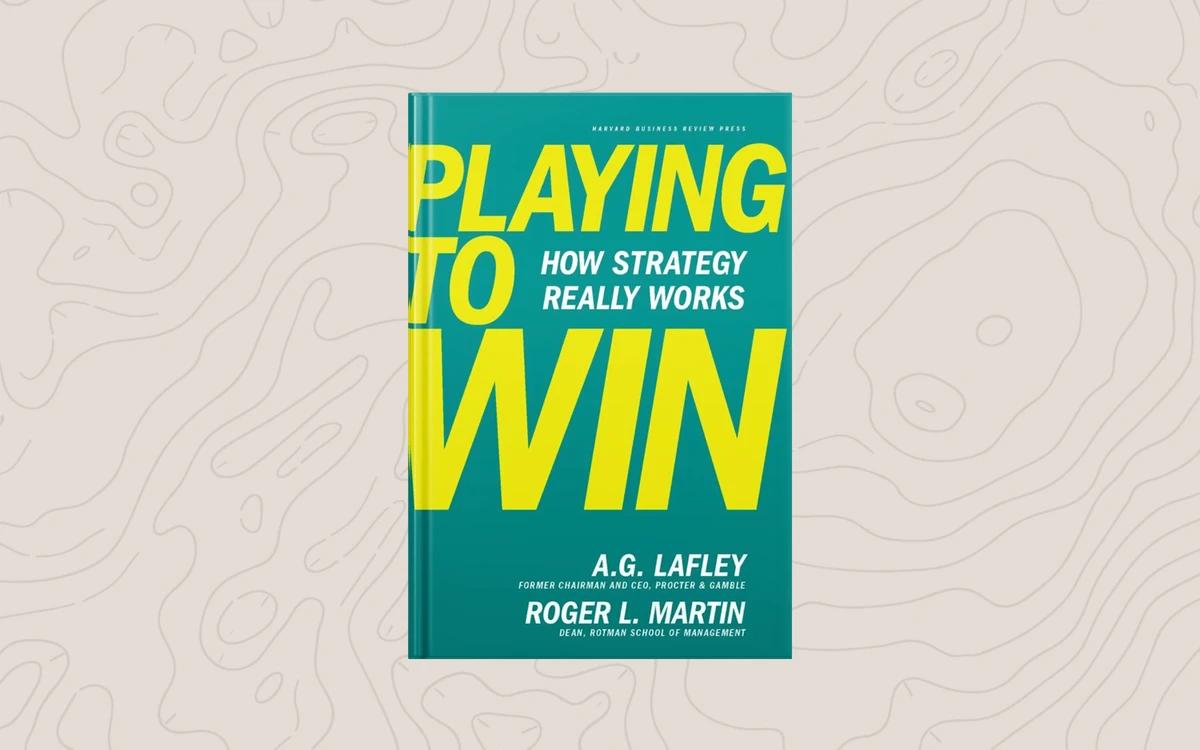
Playing to Win: How Strategy Really Works by A.G. Lafley and Roger L. Martin offers a practical framework for crafting winning business strategies. This summary distills the book's core insights into actionable takeaways you can apply to your own strategic planning process.
About Playing to Win
A.G. Lafley served as CEO of Procter & Gamble, where he doubled sales, quadrupled profits, and increased market value by over $100 billion. Roger L. Martin is a strategic advisor and former Dean of the Rotman School of Management at the University of Toronto.
Published in 2013, the book draws on Lafley's experience transforming P&G through disciplined strategic choices. The authors argue that strategy isn't about complex planning documents or elaborate processes. It's about making clear choices that position your organization to win.
The book became a Wall Street Journal and Washington Post bestseller and remains one of the most influential strategy execution guides in business literature.
Key takeaways
The following seven takeaways capture the essential lessons from Playing to Win. Each represents a foundational principle for building effective strategy.
1. Play to win, not to participate
Most companies don't actually have a strategy. They have goals, plans, and aspirations—but they lack the discipline to make real choices. The authors draw a sharp distinction between playing to win and playing to participate.
Playing to participate means trying to stay in the game without committing to what it takes to dominate. Organizations that play to participate spread resources thin, avoid difficult trade-offs, and ultimately underperform.
Playing to Win vs. Playing to Participate
Playing to Win | Playing to Participate |
|---|---|
Clear choices about where to compete | Competing everywhere possible |
Focused resource allocation | Spreading resources thin |
Accepting trade-offs | Trying to please everyone |
Measurable winning aspirations | Vague goals like "grow" or "improve" |
Winning means different things in different contexts. For a consumer goods company, it might mean market leadership. For a nonprofit, it could mean maximizing social impact. The key is defining what winning looks like and committing fully to achieving it.
2. Strategy is an integrated cascade of five choices
The core framework in Playing to Win is the Strategic Choice Cascade—five interconnected questions that together form a complete strategy.
The Five Strategic Questions
- What is our winning aspiration? The purpose and motivating aspiration for your organization.
- Where will we play? The specific markets, segments, channels, and geographies where you'll compete.
- How will we win? The unique value proposition that will give you competitive advantage.
- What capabilities must be in place? The activities and competencies required to win.
- What management systems are required? The systems and measures that enable capabilities and support choices.
These questions form a cascade because each choice influences and constrains the others. Your winning aspiration shapes where you can play. Where you play determines how you can win. How you win dictates what capabilities you need.
The cascade works in both directions. While choices flow down from aspiration to systems, the lower levels also inform and constrain the higher levels. Your existing capabilities might limit where you can realistically play.
3. Where to play and how to win form the heart of strategy
The authors call "where to play" and "how to win" the heart of strategy. These two choices define your competitive positioning.
Where to play encompasses multiple dimensions:
- Geography: Which countries, regions, or cities?
- Customer segments: Which demographics or psychographics?
- Product categories: Which offerings or product lines?
- Channels: Direct, retail, online, or hybrid?
- Vertical stages: Where in the value chain will you compete?
How to win defines your competitive advantage. The authors identify two fundamental approaches, drawing on Michael Porter's work:
Strategy Type | Definition | Example |
|---|---|---|
Cost leadership | Providing equivalent value at lower cost | Walmart, Southwest Airlines |
Differentiation | Providing unique value that commands premium pricing | Apple, BMW |
You can't win without clarity on both dimensions. Choosing where to play without knowing how you'll win is wishful thinking. Knowing how to win without choosing where to apply it wastes resources.
4. Capabilities must match your strategic choices
Capabilities are the activities and competencies that enable your strategy. They're not generic "best practices"—they're specific to your where-to-play and how-to-win choices.
The authors identify five core capabilities that powered P&G's strategy:
- Deep consumer understanding through rigorous research
- Innovation in product development and brand building
- Brand building that creates emotional connections
- Go-to-market ability with retail partners
- Global scale in purchasing, manufacturing, and distribution
Your capabilities should be activity systems—interconnected activities that reinforce each other. Competitors can copy individual activities, but replicating an entire system is much harder.
Capabilities require investment. Building world-class capabilities takes years and significant resources. This is why strategic choices matter—you can't be excellent at everything, so you must choose where to invest.
This connects directly to organizational alignment. Your structure, processes, and people must all support your capability choices.
5. Strategy requires tough trade-offs
Real strategy means saying "no." Every "yes" to one opportunity is an implicit "no" to others. Organizations that try to pursue every attractive option end up with no strategy at all.
Common trade-off avoidance patterns:
- The "and" trap: Trying to be the low-cost provider AND the premium differentiated option
- Customer pleasing: Attempting to serve all customer segments equally
- Geographic sprawl: Expanding everywhere without focus
- Product proliferation: Launching products that dilute your core positioning
P&G made difficult trade-offs. They exited food and beverage businesses, sold off underperforming brands, and focused resources on categories where they could win. These choices weren't popular internally, but they enabled focused investment in priority areas.
Trade-offs create focus. When you commit to specific choices, you concentrate resources where they matter most. This focus enables excellence rather than mediocrity across the board.
6. Management systems reinforce strategic choices
The fifth element of the cascade—management systems—often gets overlooked. But without supporting systems, even brilliant strategic choices fail in execution.
Management systems include:
- Planning processes that align the organization around strategic choices
- Performance measures that track progress on strategic priorities
- Resource allocation that directs investment toward capabilities
- Incentives that reward behaviors aligned with strategy
- Communication that keeps everyone focused on what matters
Strategy Without Systems
Many organizations create beautiful strategy documents that sit on shelves. The strategy exists in presentations but not in daily decisions. Management systems bridge the gap between strategic intent and organizational action.
Feedback loops matter. Your systems should generate data about whether your strategy is working. This enables learning and adaptation as market conditions change.
Tools like OKRs and balanced scorecards can help translate strategic choices into measurable objectives that cascade through the organization. Regular check-ins ensure teams stay aligned with strategic priorities.
7. Reverse engineering helps test strategic logic
The authors introduce a powerful technique for testing strategy: reverse engineering. Rather than arguing about whether a strategy is right, ask what would have to be true for it to succeed.
The reverse engineering process:
- Generate strategic possibilities without initially judging them
- For each possibility, identify conditions for success: What must be true about customers, competition, capabilities, and costs?
- Identify barriers to each condition: What concerns or doubts exist?
- Design tests: How would you determine if the condition is actually true?
- Conduct tests and make choices: Let evidence guide the decision
This approach shifts debates from advocacy to inquiry. Instead of defending positions, teams explore what must be true for different options to work.
Example conditions to test:
Condition Category | Sample Question |
|---|---|
Customer demand | Will customers actually pay for this differentiation? |
Competitive response | Can we sustain advantage if competitors react? |
Capability feasibility | Can we build the required capabilities? |
Financial viability | Will this generate acceptable returns? |
This framework reduces the risk of confirmation bias. When you test assumptions rigorously, you're less likely to pursue strategies that feel good but lack foundation.
Playing to Win book review and limitations
Playing to Win holds a 3.99 rating on Goodreads from over 8,900 readers. The Financial Times called it "a manual for business strategy", and Fortune praised its insightfulness and accessibility. However, reviewers have noted several limitations.
Heavy reliance on P&G examples: Nearly all case studies come from Procter & Gamble. While Lafley's firsthand experience makes these stories vivid, readers from other industries may struggle to translate lessons to their context.
Limited applicability for smaller organizations: The framework was developed for a Fortune 500 company with global scale. Startups and small businesses face different strategic constraints that the book doesn't address.
Promotional tone: Some readers found the book reads like a P&G success story rather than objective strategic guidance. The self-congratulatory tone can undermine the otherwise solid frameworks.
Lack of failure analysis: The book presents a string of strategic successes without deeply examining P&G's failures or near-misses. Learning from what went wrong would strengthen the lessons.
Who should read this book?
Playing to Win is ideal for executives, strategists, and managers responsible for shaping organizational direction. You'll gain a clear framework for making strategic choices and the vocabulary to facilitate strategy conversations. The book works best for leaders in mid-to-large organizations seeking a disciplined approach to strategy development.
Related reading
Mooncamp resources:
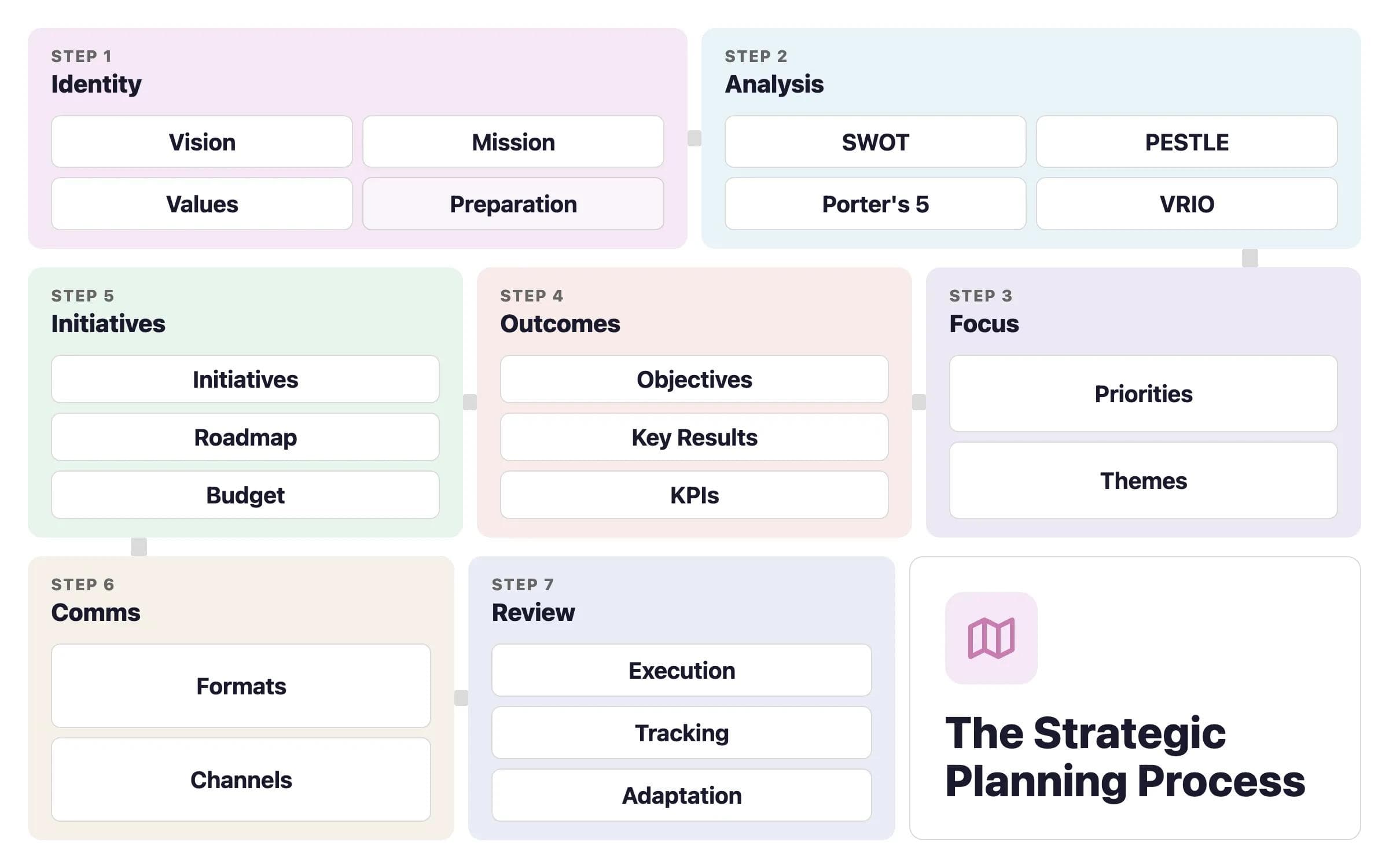
- Strategic Planning Process: A comprehensive guide to developing organizational strategy
- Strategy Execution: How to translate strategic choices into results
- Hoshin Kanri: A Japanese strategy deployment methodology
- OGSM Framework: Another integrated framework for strategy and execution
Related books:
- Good Strategy Bad Strategy by Richard Rumelt: Complements Playing to Win with focus on strategy diagnosis
- The Infinite Game by Simon Sinek: Offers a contrasting perspective on the concept of "winning"
- Competitive Strategy by Michael Porter: The foundational work on competitive positioning