- Strategy is not ambition, vision, or goals: A goal states what you want, while a strategy states how you will get past whatever is currently stopping you.
- Every good strategy has a three-part kernel: A diagnosis names the challenge, a guiding policy picks an approach to it, and coherent actions carry that policy out.
- Diagnosis does the heavy lifting: Most strategy work is comprehending the situation, and naming the wrong condition collapses every choice that follows it.
- Bad strategy has four recognizable hallmarks: Fluff, failure to face the challenge, mistaking goals for strategy and bad strategic objectives are visible on the page.
- Focus creates power, and focus means saying no: Strategy concentrates strength on a few pivotal points, which requires abandoning the interests that spreading resources protects.
- Choose proximate objectives you can actually hit: A leader absorbs ambiguity and converts a distant ambition into a near target the team can reasonably be expected to reach.
- Coherent actions must reinforce one another: Coordinated actions that strengthen each other are the punch in a strategy, not implementation detail to delegate away.
Good Strategy Bad Strategy: The Difference and Why It Matters by Richard Rumelt argues that most of what organizations call strategy is not strategy at all, and that the difference is visible on the page to anyone who knows what to look for. This summary distills the book's core insights into seven takeaways you can apply to your own strategy documents and goal trees.
About Good Strategy Bad Strategy
Richard P. Rumelt is Emeritus Professor of Business and Society at the UCLA Anderson School of Management, where he held the Harry and Elsa Kunin Chair. He took his doctorate in business at Harvard Business School, taught there before moving to UCLA, and began his career as a systems engineer at the Jet Propulsion Laboratory.
The Economist named him one of twenty-five living people with the most influence on management concepts and corporate practice. His academic work founded the systematic study of corporate diversification strategy and helped establish the resource-based view of the firm.
Published in 2011 by Crown Currency, an imprint of Penguin Random House, the 336-page book reacts against an industry that turned strategy into a planning ritual. Rumelt's target is the document that pairs a stretch financial target with a mission statement, a values list and thirty initiatives, then calls the combination a strategy. His counterclaim is that a strategy is a coherent response to a specific, honestly named challenge, and that bad strategy is an active failure rather than the mere absence of good work.
The publisher reports more than 200,000 copies sold, and the Financial Times called it the most interesting business book of 2011. Its vocabulary of diagnosis, guiding policy and fluff has been absorbed into how strategy teams now talk about their own documents. For the goal-setting mechanics this book deliberately leaves out, see our roundup of the best OKR books.
Key takeaways
The following seven takeaways carry the transferable arguments in Good Strategy Bad Strategy. Each one moves from a claim about what strategy is to a test you can run on the document currently sitting in your own planning folder.
1. Strategy is not ambition, vision, or goals
Rumelt's opening move is definitional demolition. Ambition, leadership, vision, planning and the economic logic of competition each get mistaken for strategy, and none of them is one.
A goal states what you want. A strategy states how you will get past whatever is currently stopping you, which means it has to name the obstacle before it can name a response.
The practical test is whether the document names an obstacle at all. If it does not, what you are holding is a budget or a wish list wearing a strategy's clothes.
Presented as strategy | What it actually is |
|---|---|
Grow revenue 20 percent | A financial target |
Be the firm of choice | An aspiration |
A mission and values statement | Identity, not method |
The annual planning deck | A budget with pictures |
A 30-item initiative list | A to-do list |
This is the takeaway that lands hardest on anyone running a goal program. A fully populated objective tree can satisfy every ceremony in the quarter and still contain zero strategy, because nothing in it is required to name a challenge.
The same test applies upstream of the goal tree. A vision statement describes the future you want to live in, which is a legitimate and useful thing to write, but it is identity rather than method and it cannot be evaluated for correctness.
2. Every good strategy has a three-part kernel
Underneath every strategy Rumelt is willing to call good, he finds the same three-part logical structure. He calls it the kernel, and it is short by design.
The kernel is a structure, not a process. It tells you whether what you have is a strategy; it does not tell you how to run the workshop that produces one.
The three elements, and what breaks when one is missing
- A diagnosis: defines or explains the nature of the challenge, simplifying overwhelming complexity by naming certain aspects of the situation as critical. Absent, you optimize the wrong thing.
- A guiding policy: the overall approach chosen to cope with or overcome the obstacles the diagnosis identified. Absent, you get a list of disconnected projects.
- A set of coherent actions: feasible, coordinated resource commitments designed to carry out the guiding policy. Absent, you get a strategy deck nobody acts on.
The middle element is the one most readers get wrong. A guiding policy is not a goal, a vision or a plan; it is an overall approach that directs some actions and rules out others without fully specifying the steps, chosen from among rival approaches to the same diagnosed obstacle.
Because each element constrains the next, the kernel also works backwards as an audit. Take any action currently funded, ask which guiding policy it carries out, then ask which diagnosis that policy answers, and see how far up the chain you get before the answer runs out.
3. Diagnosis does the heavy lifting
Rumelt treats diagnosis as the scarce skill, not choice-making. Most of the work of strategy is figuring out what is actually going on and replacing an overwhelming situation with a simplified account of which few things are critical.
A good diagnosis works like a medical one. Naming the condition immediately implies a class of treatments and rules out others, which is what makes it useful rather than merely descriptive.
Weak diagnosis is the most common origin of bad strategy, and the characteristic failure is diagnosing your own challenge as underperformance. Underperformance is a symptom, not a condition, and a strategy built on it can only prescribe trying harder.
Weak diagnosis | Usable diagnosis |
|---|---|
We are underperforming | Our cost per unit is 30 percent above the two competitors who set market price |
Growth has stalled | Our core segment is saturated and our sales model cannot reach the adjacent one |
Competition is intense | Two rivals have bundled our product into a suite we cannot match |
We need to be more innovative | Product decisions require six sign-offs, so nothing novel survives review |
The corollary is uncomfortable. Since the entire kernel hangs off the diagnosis, getting it wrong collapses everything downstream, which is an argument for spending far more of the planning cycle on the left-hand column than most teams do.
It is also an argument against running a template in place of the analysis. A SWOT analysis produces four populated boxes whether or not anyone has understood the situation, and a filled-in grid feels enough like progress to end the conversation early.
4. Bad strategy has four recognizable hallmarks
Bad strategy is not simply the absence of good strategy. It grows out of specific misconceptions and leadership dysfunctions, which means it has a signature you can learn to spot.
Rumelt gives four tells that let anyone audit a strategy document in ten minutes. The diagnostic value is that all four are visible on the page, without any insider knowledge of the business.
The four hallmarks and how to spot each one
- Fluff: abstract nouns, coined phrases and restated obviousness. Tell: delete the adjectives and nothing remains.
- Failure to face the challenge: no obstacle is named anywhere. Tell: you cannot say what would make this strategy wrong.
- Mistaking goals for strategy: targets and percentages with no method attached. Tell: every line answers what, none answers how or why now.
- Bad strategic objectives: blue-sky objectives that restate the problem as the solution, or a scattershot list of twenty initiatives. Tell: no item is more important than any other.
Rumelt also names the political mechanism that produces all four. A strategy everyone agrees to enthusiastically is usually one that made no choices, because any real choice makes somebody in the room worse off.
Two of the hallmarks show up as goal-setting failures rather than strategy failures, which is why they survive so long inside otherwise disciplined programs. The third and fourth are the source of several entries on our list of common OKR mistakes, and a strategic planning process that produces a calendar without producing a diagnosis will reproduce them every year.
5. Focus creates power, and focus means saying no
Rumelt's mechanical definition of strategic power is the application of strength against weakness, or of strength against the most promising opportunity. Concentration is what converts ordinary resources into a disproportionate result.
Complex organizations almost never do this. They spread resources across internal and external constituencies to avoid the political cost of refusing anyone, and so achieve a breakthrough in nothing.
The concentration logic runs through several of the book's nine sources of power:
- Leverage combines anticipation, insight into the pivot point, and a concentrated application of effort at that point.
- Focus means resourcing one or two objectives heavily enough to break through, rather than funding twelve at a level that guarantees none of them moves.
- Saying no is the cost of both, and it is psychological, political and organizational work rather than an analytical step.
- Universal enthusiasm is a warning sign, because a choice that nobody resents probably was not a choice.
- Opposition is structural, since any real change in strategy makes some people inside the company worse off.
The uncomfortable version for anyone allocating resources is that the hard part is not picking the winner. It is defunding the four things that were fine, sponsored by people who will be in the next meeting.
Concentration is also what makes a position defensible. Strategic positioning that survives contact with competitors comes from putting disproportionate strength behind one point of difference, not from being adequate across a wide front.
6. Choose proximate objectives you can actually hit
This is Rumelt's most contrarian idea for a goal-setting audience. A leader's job is to absorb ambiguity on behalf of the organization and convert a distant, murky ambition into a proximate objective, meaning a target close enough at hand that the team can actually reach it.
Hitting that target then resolves enough uncertainty to make the next proximate objective visible. The skill is building and continually re-adjusting the bridge between the far-off ambition and the near target that is currently reachable.
The example he uses is the one most likely to be misread. Rumelt reads the Apollo moon landing as a carefully chosen proximate objective rather than a leap of faith, because a decade of prior engineering work had already reduced the unknowns enough to make the target hittable.
Why the moon landing is not a moonshot in Rumelt's sense
Kennedy's target looked audacious from outside and was tractable from inside. The propulsion, guidance and life-support problems had been worked down far enough that the remaining question was scale and sequencing rather than feasibility. Rumelt's point is that the ambiguity had already been absorbed before the objective was announced, which is the opposite of announcing a target in order to force the ambiguity onto the teams below.
That reading cuts directly against how the word is used in goal setting today. A moonshot goal is deliberately set beyond current capability so that missing it is expected and 70 percent counts as success, whereas a proximate objective is chosen precisely because it can be hit, and missing it is a signal that the diagnosis was wrong.
Neither is universally right, but they answer to different conditions. Use a stretch target where the constraint is ambition and the path is known, and use a proximate objective where the constraint is ambiguity, which is the situation the strategy is supposed to resolve.
7. Coherent actions must reinforce one another
The third element of the kernel is the one that routinely gets dismissed as implementation and handed downwards. Rumelt refuses that framing, arguing that coherent actions are the punch in a strategy rather than a detail arriving after the thinking is finished.
Coherence is a stronger condition than compatibility. Actions are coherent when each one makes the others more effective, not merely when they coexist in the same plan without contradicting each other.
A coherent set of actions | A list of initiatives |
|---|---|
Designed to carry out one guiding policy | Chosen independently by each unit |
Coordinated so each strengthens the others | Coordinated only enough to avoid conflict |
Immediate resource commitments | Statements of intent with owners attached |
Imposed by policy and design | Produced by ad hoc mutual adjustment |
Maintained deliberately as conditions change | Left to decay once the plan is published |
The blunt part of the argument is that coordination is imposed and costs something. It fights the natural pull of specialization and local optimization, and it does not emerge from decentralized goodwill, which is why coherence has to be designed into the plan rather than hoped for during delivery.
A strategy that names no plausible and feasible immediate actions is missing a component, not waiting for a delivery phase. This is where the book meets the practical work of strategy execution, and where an organization discovers whether its guiding policy was ever specific enough to constrain anything.
Good Strategy Bad Strategy book review and limitations
Good Strategy Bad Strategy holds a 4.12 rating on Goodreads from over 18,000 readers. The Financial Times called it the most interesting business book of 2011, and Strategy+Business named it the year's best and most original addition to the strategy bookshelf. However, reviewers have noted several limitations.
The guiding policy is under-specified: Roger Martin, co-author of Playing to Win, writes that he did not find the advice on developing guiding policies as actionable as he wanted. He also objects that telling leaders to make their actions coherent names the desired property without saying how to produce it, in the way that telling a screenwriter to write an exciting script does.
It is stronger at demolition than at construction: The book is at its best dismantling what passes for strategy and much weaker as a manual for building one. It offers no process by which an executive team could sit down together and produce a strategy, which is the single most common complaint about the book.
The case studies are read with hindsight: Successes are labeled good strategy and failures bad strategy once the outcome is already known, which makes every winner look like a deliberate strategist. Readers also object that the extended narrative sections drift into storytelling, and that the closing material on asset-market boom and bust cycles sits well outside the argument.
Everything hangs on a single diagnosis: Because the whole kernel is bolted to one judgment about the most important challenge, a wrong diagnosis quietly invalidates the entire strategy built on it, and the book says little about how to tell in advance. The framing also leans heavily on competitive threat, giving less attention to slow-building obstacles such as regulatory shifts or internal capability gaps. Several readers add that the argument is repetitive and could have been made in half the pages.
Who should read this book?
Good Strategy Bad Strategy is for people who own or contribute to an annual strategy, particularly executives, founders and senior functional leaders in organizations of 100 to 5,000 people where the planning ritual already exists but the strategy behind it does not.
It is unusually valuable for the people holding a goal tree that no strategy sits above. Strategy leads, OKR program owners and chiefs of staff walk away with precise language for naming that gap without sounding obstructive, plus a ten-minute audit they can run on any document they are handed.
It lands less well for anyone who wants a step-by-step method, since the book is a diagnostic lens rather than a process. Individual contributors and small-team managers below the level where resources are actually allocated will find the cases remote, and readers who want current examples will notice that everything is anchored in 2011 or earlier.
Related reading
Mooncamp resources
- Playing to Win Book Summary: The five-choice cascade that produces a strategy, where Rumelt gives the test for recognizing one
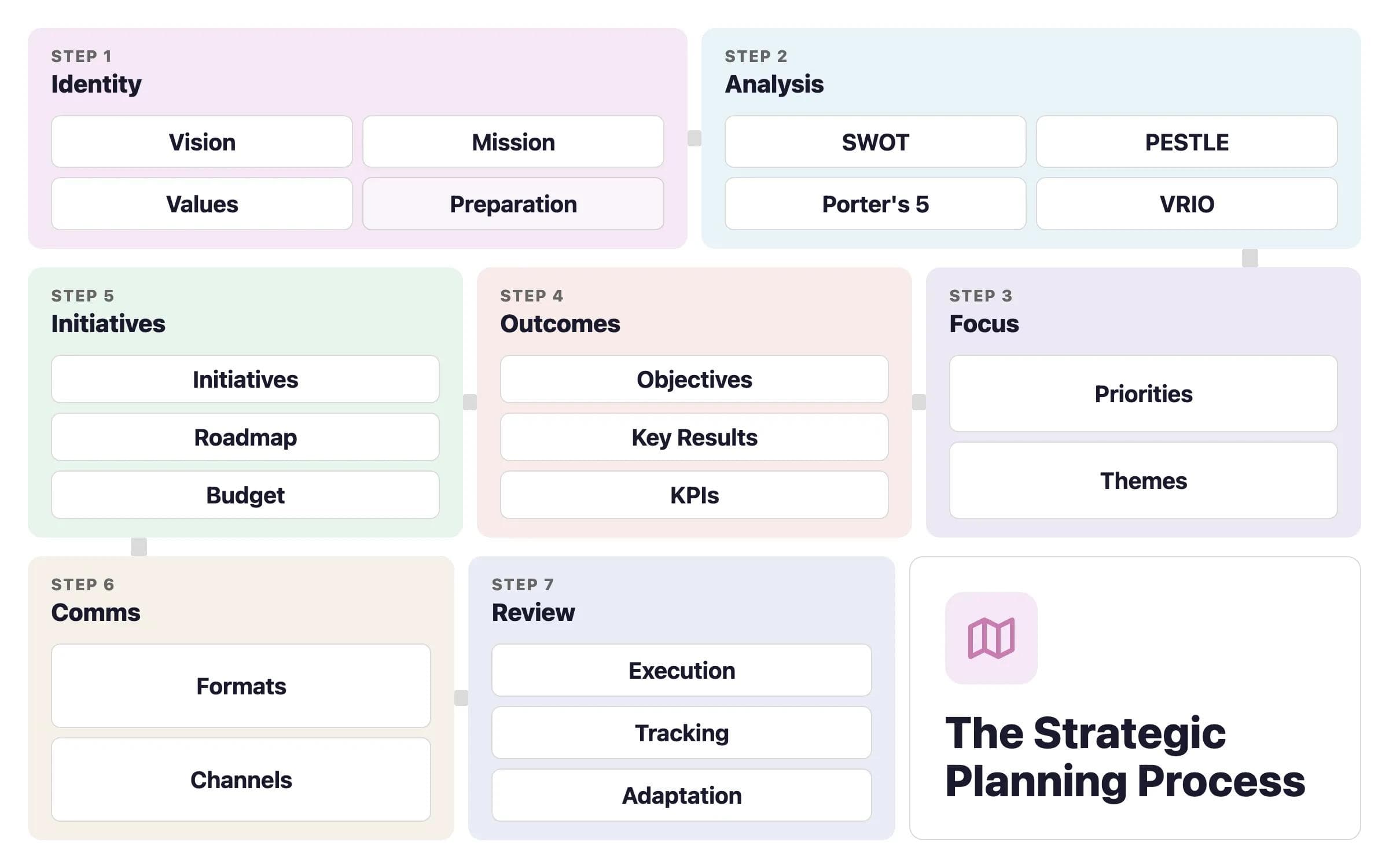
- Strategic Planning Process: The seven-step process a diagnosis has to sit inside
- Strategy Execution: Turning a guiding policy into coordinated action that survives the quarter
- Strategic Choice Cascade: Lafley and Martin's cascade as a defined term, for comparison against the kernel
Related books
- Playing to Win by A.G. Lafley and Roger L. Martin: The complementary half, giving a five-question cascade for producing the strategy Rumelt teaches you to recognize
- The Crux by Richard P. Rumelt: The author's own sequel, turning the diagnosis step into a method for finding the addressable part of a challenge
- 7 Powers by Hamilton Helmer: A rigorous taxonomy of the durable advantages a guiding policy can be built on
- Zero to One by Peter Thiel: The market-selection argument that decides what a guiding policy is aiming at in the first place