- Pick one objective, not a portfolio: Wodtke prescribes one company objective per quarter with one supporting set per team, because a team running five objectives is running none.
- An objective is a mission for three months: The objective is qualitative and inspirational and may be unmeasurable, because the three key results underneath it carry all the numbers.
- Set key results at five of ten confidence: A key result you are only fifty percent sure of hitting is set right, and the number gets updated every single week.
- Cadence turns goal setting into goal achieving: Monday commitments and Friday wins are the book's actual thesis, and OKRs reviewed only at quarter end have not been adopted.
- Put the whole week on one four-box page: The Monday status sheet holds intention for the week, forecast for month, status toward OKRs, and health metrics, and nothing else.
- Never wire OKRs into pay: Tying key results to bonuses destroys the fifty-fifty target, because every rational employee then commits only to numbers they can already hit.
- Grade to learn, not to pass: The value of grading sits in the honest conversation about which of the quarter's hypotheses held, not in a pass or fail verdict.
- Align through trust, because cascading does not scale: Wodtke reversed her own cascade advice, arguing that beyond one or two levels of hierarchy alignment has to come from empowered teams.
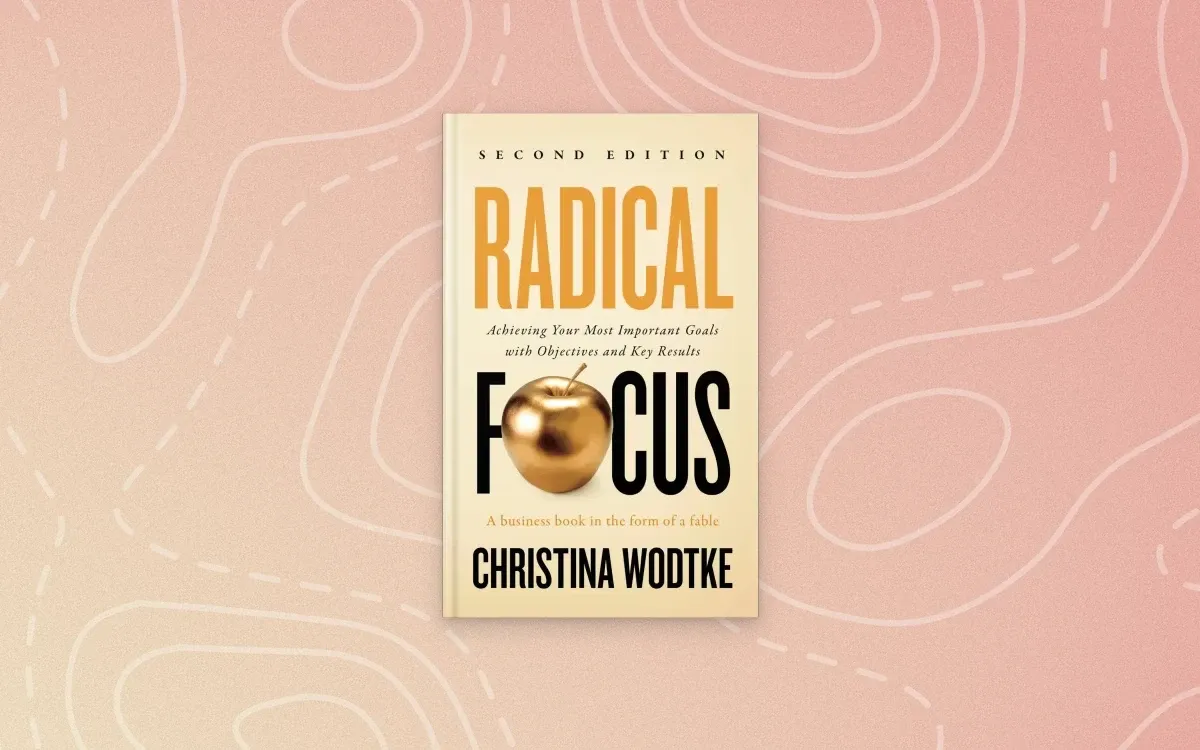
Radical Focus by Christina Wodtke is half business fable and half OKR handbook, written by a Silicon Valley product leader who now teaches at Stanford. This summary distills its core insights into eight takeaways you can run inside a single team, starting with next Monday's meeting.
About Radical Focus
Christina R. Wodtke teaches at Stanford University, where her courses include CS177 Introduction to Product Management with AI (previously Human-Centered Product Management), CS247B Design for Behavior Change, CS247G Design for Play and CS377G Designing Serious Games. Before teaching she ran product and design at scale: General Manager of Zynga.com at Zynga, General Manager of Social at Myspace, Principal Product Manager at LinkedIn, and Senior Director of Design at Yahoo.
She also founded the design magazine Boxes and Arrows, co-founded the Information Architecture Institute, and founded a startup that built the collaborative blogging tool PublicSquare. That background matters for how the book reads: Wodtke is a practitioner turned teacher rather than an investor, which is why her book is operational where most OKR writing is evangelical.
Cucina Media LLC published the first edition in February 2016 and a second edition on 20 April 2021, running 254 pages against 160 in the original paperback. Wodtke is reacting against two failures at once.
The first is the ordinary one, where a team writes goals at an offsite and reverts to whatever is loudest by week three. She traces that to five causes: no prioritisation of goals, not communicating the goal enough, no clear plan to execute, not making time for what matters, and giving up instead of iterating. On the communication point she borrows a line from LinkedIn chief executive Jeff Weiner: "When you're tired of saying it, people are starting to hear it."
The second failure is sharper, and it is the OKR programme that has already been adopted and is quietly dying. Goals were set for every function, cascaded down a hierarchy, graded like a scorecard and wired into performance reviews, and her diagnosis is that the framework survives contact with a real company only if it is kept small and kept out of the compensation system.
The book reached its audience without a newspaper bestseller listing, which is the normal fate of a self-published title. By the publisher's own count it has sold more than 50,000 copies and been translated into six languages, and it is a fixture on lists of the best OKR books.
The second edition added 22,000 words of new material aimed at OKR users in larger organisations, covering how to create, grade and manage OKRs, plus 50 example OKR sets.
Key takeaways
The eight takeaways below follow the shape of the book. Three cover the anatomy of an OKR, two cover the weekly rhythm that carries it, and the last three cover compensation, grading and what happens when you try to run any of it at scale.
1. Pick one objective, not a portfolio
The word radical in the title is a quantity claim, not a temperament one. Wodtke's rule is one company objective per quarter with one supporting OKR set per team, and she is blunt that a team running five objectives is running none.
The reasoning is capacity rather than purity. A quarter contains a fixed number of weeks, and each additional objective removes weeks from the others without anyone deciding to.
She also fences OKRs off from routine work. OKRs are for the change you want this quarter, not for everything the team does, and her diagnostic question is what change you want to see this quarter. If the honest answer is none, the thing you want is a KPI.
- One company OKR: start with only one company OKR and one supporting OKR set per team.
- Three key results: typically three, though she has seen as many as five and as few as one work.
- Not for everything: do not set OKRs for everything you do, save them for critical strategic efforts.
- Change, not steady state: OKRs are for when you need a team to focus on making a significant change.
The practical consequence is that most OKR sets you have seen are too big to be OKRs. If your company list has eight objectives on it, you have written a plan and called it a focus mechanism.
2. An objective is a mission for three months
Wodtke's definition of an objective is the cleanest in the OKR literature: a mission statement with an expiry date. Where a mission runs about five years, an objective runs one quarter, so an objective is what a mission looks like with three months on the clock.
The objective carries the meaning and does the motivating, and it is allowed to be unmeasurable precisely because the key results underneath it are not. The pairing is deliberate: the objective motivates the people who do not care about numbers, and for those who do, the key results keep the objective real.
Objective | Key Results | |
|---|---|---|
Question it answers | What are we trying to do? | How will we know we did it? |
Register | Qualitative, inspirational | Quantitative, verifiable |
Timespan | One quarter, where a mission runs five years | One quarter |
How many | One | Three, occasionally one to five |
Her test | You leap out of bed eager to make it happen | They scare you slightly |
Her two personal tests are the useful part, because they are the only quality bar in the book that does not require a spreadsheet. If the objective does not get you out of bed it is a task list, and if the key results do not frighten you a little they are a forecast.
The relationship runs upward as well. A mission is what keeps the OKRs pointed somewhere, and OKRs set without one are jet fuel without a jet.
3. Set key results at five of ten confidence
This is the book's most portable single instruction and the one you can adopt on Monday. Rather than arguing about whether a key result is stretch enough, the team states a number: how confident are we, out of ten, that we hit this?
The target at the moment of setting is five, which is a 50/50 shot of failing. Wodtke defines both ends of the scale so the number cannot be fudged.
- 1 means, in her words, "never gonna happen my friend"
- 5 is where a key result should start the quarter, a 50/50 shot of failing
- 10 is, again in her words, "also known as sandbagging"
Then she makes the number a living signal rather than a one-off estimate: adjust your confidence levels every single week, and explain the movement when it happens. The rating is not a forecast, it is a conversation trigger.
Teams cheat this number when guessing is punished, which is why she treats the fix as cultural rather than numerical. Where there is no baseline to work from, her answer is that you guess, because guessing is how a team builds the knowledge it does not have yet.
4. Cadence turns goal setting into goal achieving
This is the actual thesis and the reason the book exists alongside the rest of the OKR shelf. Wodtke's claim is that the OKR template is trivial and the weekly rhythm is the hard part, so a company that writes beautiful OKRs and reviews them at quarter end has not adopted OKRs at all.
The rhythm has two fixed points. Monday is where each team commits in public to the three or four things it will do this week toward the objective, and Friday is where every team demos what it actually finished.
Monday supplies accountability and Friday supplies the emotional fuel that keeps a hard quarter from grinding people down, and she insists you need both. She calls the pair a cadence of commitment and celebration, and the Friday session is cross-functional on purpose: it is where sales sees what engineering built and engineering sees who sold it. Engineers show working code, designers show mockups, sales shares closed deals, support shares rescued customers, and refreshments are treated as part of the mechanism rather than a perk.
The Monday meeting has two hygiene rules worth stealing. Have fewer priorities and shorter updates, and watch the time split: if only a third of the time allotted for the Monday meeting is presentations and the rest is discussing next steps, you are doing it right. A modern OKR check-in is this meeting with a tool attached.
One adjacent rule holds the whole thing together: do not change the OKR halfway through the quarter. Suck it up, either fail or blow past the target, and use the learning to set the next set better.
5. Put the whole week on one four-box page
The Monday status sheet is the book's most copyable artefact and the reason it reads as a handbook rather than a manifesto. It is one page split into four quadrants, and the discipline is that nothing else goes on it.
Two quadrants look forward, one looks at the goal, and one looks at what you are protecting while you chase it.
Position | Quadrant | The prompt, in her words |
|---|---|---|
Upper left | Intention for the Week | "what are the 3-4 most important things you must get done this week toward the Objective?" |
Lower left | Forecast for Month | "What should your team know is coming up that they can help with or prepare for?" |
Upper right | Status toward OKRs | "If you set a confidence of 5 out of ten, has that moved up or down? Have a discussion about why." |
Lower right | Health Metrics | "Pick two things you want to protect as you strive toward greatness. What can you not afford to eff-up?" |
The fourth quadrant is the underrated one. Health metrics force a team to name in advance the two numbers it is not allowed to break in pursuit of the objective, which is the guardrail against hitting a revenue key result by wrecking churn. Two, not ten.
It also answers the question every OKR rollout runs into, which is what the existing dashboard is supposed to do while OKRs are running. Her later formulation is that key performance indicators are your dashboard and OKRs are your GPS when you are driving somewhere you have never been.
6. Never wire OKRs into pay
Wodtke's position here is more mechanical than the usual fairness argument. Linking OKRs to compensation is not merely unkind, it destroys the one property that makes an OKR useful, which is a target set at 50/50 confidence.
The instant a bonus depends on the number, every rational employee sets a number they can already hit, and the framework quietly degrades into an annual target agreement with new vocabulary. Her one-line version is that if you tie OKRs to performance reviews and bonuses, employees will always underestimate what they can do.
- Run reviews every quarter, because a year is too long to wait.
- Have the employee write a short summary of accomplishments, sourced from the OKR status updates that already exist.
- Have managers read those to see who is moving the needle and who is not.
- Have the hard conversations early and often.
- Reward what people do, not how good they are at working the system.
Note what this is not. It is not an argument against performance management, it is an argument for a separate quarterly review that reads a person's accomplishments and uses OKR status updates as evidence rather than as a score.
There is a second, independent reason to keep the two apart, and it is about gaming. Judging people by raw numbers without conversation and context produces hacks rather than results, which is the same failure mode Google's own guidance points at when it says OKRs are not synonymous with performance evaluation. Anyone reconciling the two systems in practice will find more detail in our guide to OKRs and performance management.
7. Grade to learn, not to pass
This is second edition material, and it is the reframe that separates Wodtke from the scoring culture that grew up around OKRs. She argues that grading is a learning exercise rather than a verdict, and that its value sits in the honest conversation that produces the grade.
The reason is that the quarter's priorities were hypotheses. Grading is when you find out which of them held, so the weekly confidence check and the quarterly grade have the same purpose: turning a company into something that learns faster than its competitors.
She names three ways to learn, which she calls instruction, action and reflection, and says the most important is the least practiced, which is reflection. The weekly version of that reflection fits in two questions: what did we try, and what did we learn? When someone misses a key result, the conversation is not why did you fail, it is what did we learn.
She is explicit about what happens without the loop. OKRs without focus and a cadence of learning become an exercise in making your numbers, which is the failure mode most OKR programmes actually die of.
She published a draft of this material on her blog before the second edition shipped. In her separate writing on tracking and evaluating OKRs she reports the Google convention of scoring on a 0.0 to 1.0 scale with a sweet spot around 0.6 to 0.7, and Ben Lamorte's rule that the scoring criteria for each key result must be defined when the key result is written.
8. Align through trust, because cascading does not scale
This is the clearest change between the two editions. The first edition described a cascade: the company sets an objective and three key results, each business unit sets an objective and three key results supporting it, and so on down the hierarchy.
Wodtke has since posted a disclaimer on the blog post that laid out that cascade, and publicly reversed her position, writing that the cascade does not scale at all and might make sense only when the organisation has one or maybe two levels of hierarchy. The mechanism of the failure is queueing: waiting for sign-off at each tier turns the quarter into a line.
The replacement is high-level company OKRs plus autonomous teams writing their own aligned OKRs, with a short review to catch genuine misalignment. Her scaled model has three prerequisites, in her order: hire well, give up control of tactics to achieve company goals, and trust your teams.
- Who writes them: all self-sufficient teams can set their own OKRs, meaning autonomous, empowered teams that have all the resources they need to proceed.
- The review: short, ideally inside 24 hours, on the principle that the best is the enemy of the good.
- The precondition: OKRs only work for empowered teams, and where teams are not empowered she calls OKRs a travesty.
- A phrase from her original cascade post that still fits: unity of goal, individuality of tactics.
The consequence for anyone rolling out OKRs above a couple of hierarchy levels is that alignment has to be earned through strategy and trust rather than enforced through a tree of nested goals.
Radical Focus book review and limitations
Radical Focus holds a 3.96 rating on Goodreads from more than 4,600 ratings and 460 written reviews, pooled across all fifteen editions. No major newspaper or business magazine review could be found, which is the normal fate of a self-published book, so its praise comes from named practitioners instead: the OKR consultant Felipe Castro, founder of OutcomeEdge, calls her one of the four people who shaped OKRs into the tool they are today. However, reviewers have noted several limitations.
Half the book is a business novel: Roughly half the book is a fable about Hanna and Jack, co-founders of a struggling tea startup whose only investor demands a working OKR programme or the investment goes. The most repeated criticism on Goodreads is that this half is padding, with reviewers putting the useful material at somewhere between five pages and a single sheet, and several saying they skipped to the handbook and lost nothing.
The author has since withdrawn part of the first edition's advice: The 2016 edition's cascade guidance is the clearest case, and Wodtke now argues the opposite of it. She has also written that OKRs do not fit every team, since service teams and maintenance crews tend to struggle with them, which is a real limit on a book that reads as universal.
The book cannot decide what it is: It is part overview, part fable and part testimonial, and reviewers argue it would have been stronger committing to one. That criticism has more force against the second edition, where 22,000 words of enterprise handbook material were appended to a startup fable without the fable being rewritten to match.
Self-publishing shows in the prose: Cucina Media LLC is the author's own imprint, and multiple reviewers flag grammatical and spelling errors. Some readers are also harsh about the fiction itself rather than just its length, with one Goodreads reviewer saying it reads like a bad romance novel.
Who should read this book?
The sweet spot is founders and heads of product at companies of roughly 10 to 200 people who have already tried OKRs and watched the programme go quiet by week four. The book is diagnostic for exactly that reader, because it names the reasons goals die and hands over a fix shaped like a week rather than a policy.
It is equally useful one level down. Every core mechanic here, meaning one objective, three key results, five of ten confidence, Monday commitments, Friday demos and the four-box sheet, can be run inside a single team without executive permission, which makes it the rare management book a team lead can act on alone. OKR champions running a first rollout get a second benefit: the fable is short enough that sceptical colleagues actually read it.
It lands less well in three places. Enterprise programme owners at thousands of employees get new material aimed at larger companies, but the fable and the core weekly cadence still assume a company small enough to fit in one Monday meeting and one Friday demo.
Anyone who needs to reconcile OKRs with an existing bonus system gets the answer do not, which is principled but offers no migration path. And readers who dislike business fables will spend half the book waiting for the handbook, which is exactly the complaint the negative reviews keep making.
Related reading
Mooncamp resources
- How to Write OKRs: Turning one objective and three key results into text a team can act on
- OKR Cycle: The quarterly loop that the weekly cadence sits inside
- OKR Scoring: Grading conventions, including the scale Wodtke reports from Google
- OKR Mistakes: The failure modes her five reasons goals fail describe
Related books
- Measure What Matters by John Doerr: The companion volume, making the case that OKRs work while Wodtke shows you what to do on Monday morning
- High Output Management by Andrew S. Grove: The upstream source, where the practice Wodtke systematised into a week was invented
- The Goal by Eliyahu M. Goldratt: The business novel that proved a management method could be taught through a struggling company and a deadline
- The Team That Managed Itself by Christina Wodtke: Her 2019 leadership fable, which turns from goal setting to building and leading a high-performing team